When Not to Bet a UFC Card: Red Flags and Filters
 Available in US
The most valuable discipline in UFC betting is sometimes skipping the card
A strange truth of sports betting: the best decision on any given card is often to not bet at all. It took me years to accept this. Every Saturday a UFC event runs, the app opens, the coupon loads, the instinct kicks in — surely there is action somewhere on this card worth taking. Sometimes there is not. The cards where I have saved the most money over my betting career are the ones I never staked on.
Not every UFC event deserves your money. Cards with multiple short-notice replacements, cards with weigh-in drama that compromises the whole fight order, cards where integrity monitors have flagged unusual betting patterns — these are the cards where skipping is the right call. The instinct to bet something always is the casual punter’s enemy. Learning to skip is how you avoid the weekends that would otherwise sink your month.
What I want to lay out is the specific red flags that push me to skip or reduce exposure on a UFC card, how short-notice replacements break your pre-fight read, what a weigh-in miss actually does to fair pricing, why suspended pre-fight markets are a warning signal, and how the Dulgarian integrity case in November 2025 reshaped how I think about skipping fights entirely.
Short-notice replacements and why they wreck your read
Short-notice fighters — fighters who step in to replace an injured opponent with a few days or less of notice — are the most common reason to skip a fight on an otherwise fine card. The replacement has not had a proper training camp, may be coming in overweight or at a different weight class, and brings a stylistic profile the original matchup analysis does not cover.
The standard UFC replacement window is one to two weeks. Occasionally a replacement happens inside a week — sometimes within days, on rare occasions within hours of the card. The shorter the notice, the more compromised the replacement’s preparation, and the more uncertain the fair price becomes.
What short-notice does to pricing. The original favourite’s price shortens because they are now facing an unprepared opponent. The replacement is priced as a substantial dog — sometimes 4/1 or longer — because the market views them as competitive only in the sense that any UFC-level fighter has a puncher’s chance. Those prices are usually directionally correct but specifically imprecise, because there is no recent tape on the replacement against this calibre of opponent in this specific weight context.
My rule on short-notice fights: unless I have specifically tracked the replacement fighter and feel I have a genuine read on their current form, I do not bet the fight either way. The favourite’s shortened price is too short to be value, and the underdog replacement is a wildcard whose true probability is genuinely unknown. Skipping the fight is the correct discipline.
There is an exception. If the original fight was one of six bets I had planned for the card, and the short-notice replacement on that one fight does not affect the other five matchups, I bet the other five as planned and skip the one affected. Short-notice issues rarely contaminate an entire card — they contaminate specific bets.
Weigh-in misses and the line shift that follows
Weigh-in Friday produces the sharpest in-week line movement in UFC betting. A fighter who misses weight — comes in over the contracted limit — has either failed their cut badly (suggesting a compromised performance on fight night) or has stopped cutting and will enter the cage heavier than the other fighter (suggesting a different kind of compromise). Either way, the matchup dynamics change.
What the market does on a weigh-in miss. The fighter who missed drifts in the moneyline by 15 to 30 points of implied probability depending on the severity of the miss and the fighter’s history with weight cuts. A first-time miss of 1.5 pounds causes less drift than a repeat miss of 4 pounds from a fighter who habitually misses. The fighter who made weight shortens correspondingly.
Whether the drift goes far enough is the betting question. In my experience, the market tends to overshoot on sensational misses — a headline-grabbing miss by a named fighter often moves the line further than the fight outcome actually warrants, creating value on backing the fighter who missed. And the market tends to undershoot on quieter misses — a small miss from an undercard fighter may not move the line enough to reflect the real compromise.
My approach on weigh-in misses. I do not bet the fight blind on Friday morning. I wait until after weigh-ins complete — usually noon or early afternoon UK time — and then reassess my pre-fight read in light of what happened on the scales. If a fighter I had planned to back missed, I almost always skip that bet, regardless of how the line has moved. The read I had was based on a healthy fighter at the proper weight, and that read is no longer valid.
The one scenario where I still bet after a weigh-in miss: if my original read was already on the fighter who made weight, the miss confirms my view at a now-even-shorter price. Small value there, but real. The miss has stripped uncertainty from the matchup in my direction.
Suspended pre-fight markets
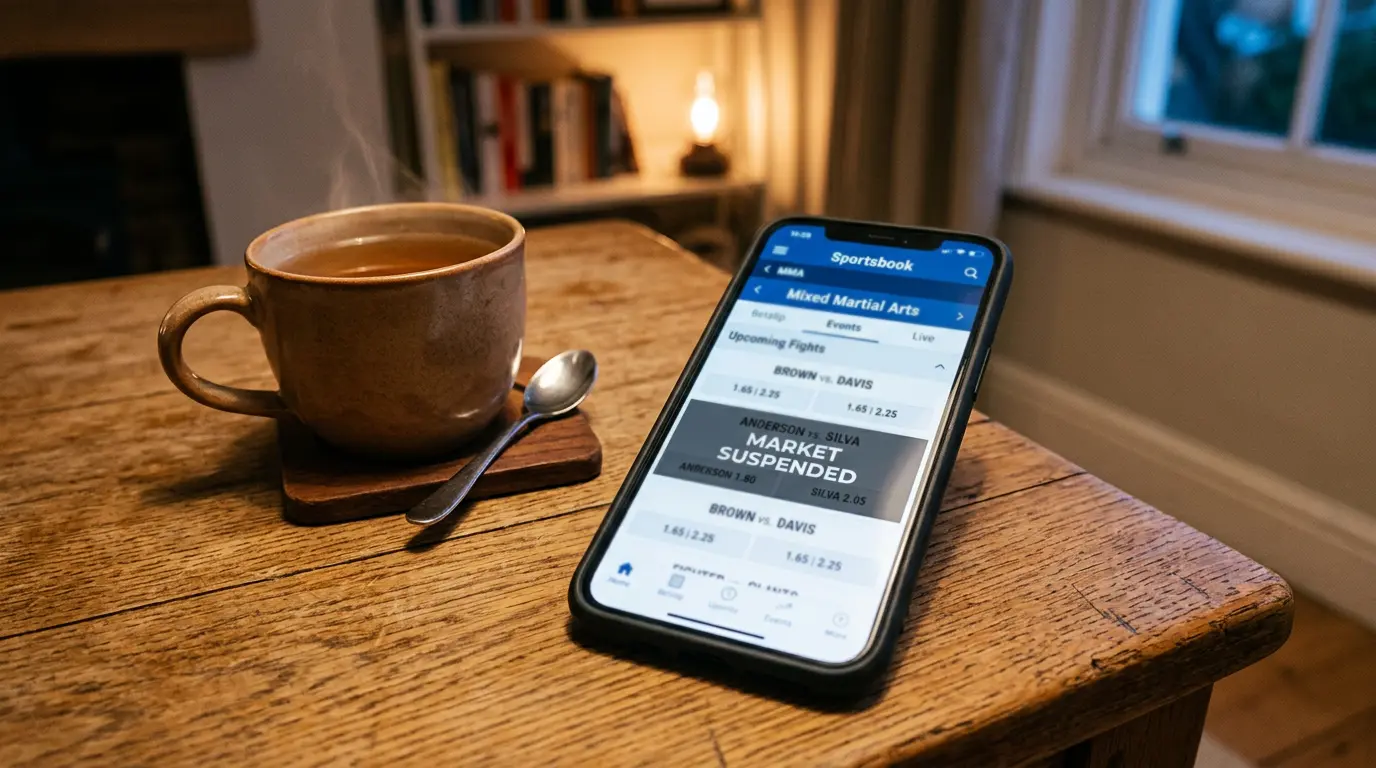
Occasionally a UK sportsbook will suspend a pre-fight market in the hours before a UFC event, without any obvious public reason. The market will show “unavailable” or “suspended” where the prices should be, and it will stay that way until something resolves. This is a signal worth reading.
Why books suspend pre-fight markets. Betting integrity concerns — the book has seen unusual volume on one side that it wants to investigate before taking more action. Regulatory instructions — UK Gambling Commission or another authority has asked for a pause. Operational issues — the book’s pricing system has a problem and cannot update, so it suspends as a safe default. Stage-one integrity alerts from IC360 — UFC’s integrity partner has flagged a pattern to the books.
The Dulgarian case on 1 November 2025 — UFC Vegas 110 — produced exactly this pattern. Dulgarian’s price drifted from around 1.40 to 1.77 and del Valle’s shortened from 3.00 to 2.10 in the hours before the fight, and several books suspended the market during the drift while they assessed. Caesars and William Hill subsequently refunded losing bets on the fight. The UFC’s statement said “UFC works with an independent betting integrity service to monitor wagering activity on our events. Our betting integrity partner, IC360, monitors wagering on every UFC event”. Dana White’s follow-up was blunter: “The first thing we did was call the FBI.”
The rule I follow since that weekend. If I see a pre-fight market suspended on a UFC fight in the hours before the bell, with no public explanation, I do not bet that fight on any other book. The suspension is a signal that something is off with the market, and betting into a market that other books are pausing is putting myself on the wrong side of information the sharp operators already have.
Integrity alerts that kill expected value
Integrity alerts are the most serious red flag on a UFC card. Since 2023, UFC has partnered with IC360, which monitors wagering on every event. The monitoring produces betting reports on every fight, and occasionally those reports flag concerning patterns that trigger action by UFC, the books, or law enforcement.
The Dulgarian versus del Valle fight on UFC Vegas 110 became the second serious integrity case in three years after the Darrick Minner and James Krause matter in 2022. Dulgarian was subsequently released from his UFC contract. The FBI became involved. Dana White told TMZ in the aftermath, “If you try to do this, we will be your worst enemy.”
What integrity alerts do to the expected value of betting. If a fight is flagged as suspicious, any bet on that fight carries two risks beyond the normal outcome risk. Risk one: the fight is fixed, which means your probability estimate on the outcome is meaningless because the outcome is not being determined by the fighters. Risk two: even if your side wins, the book may refund the bet retrospectively once the fix is confirmed, which means you do not collect even on a correct pick. Both risks are unmitigated — you cannot hedge against them or price them in.
The only correct response to an integrity alert on a fight is to stay out of it entirely. Do not bet either side. If you already have a position on a flagged fight, cash out if the option is available and skip the rest of the card as a precaution. The books that refund suspicious fights are doing the right thing by punters, but the process is slow and the uncertainty is worse than the stake size.
The UFC itself has banned all fighters, coaches and managers from betting on UFC events since 2023, which is a parallel signal that the sport takes integrity seriously. For UK punters, the practical takeaway is that integrity alerts are a rare but genuine red flag, and the Dulgarian weekend is the template for how to respond when they appear.
Building a personal skip rule
My synthesised rule for skipping UFC bets. I skip any individual fight where the matchup involves a short-notice replacement whose tape I have not watched. I skip any fight where a weigh-in miss has invalidated my pre-fight read, unless I was already on the fighter who made weight. I skip any fight where a UK book has suspended a pre-fight market without clear public reason. I skip the entire card if an integrity alert has been issued against any fight on it, and I stay away from that card until the situation resolves.
These rules combined probably eliminate 5 to 10 per cent of the bets I would otherwise make in a year. That might sound like a small share, but the fights filtered out are disproportionately the bad ones — the fights where my read was compromised or the market was compromised. Skipping them consistently is the difference between a steady long-run edge and a series of avoidable drawdowns on fights I should never have touched. For the wider context on how these filters fit with strategy, bankroll and stylistic reads, the UK betting strategy handbook brings the full framework together.
Is a short-notice UFC fighter almost always a bad bet?
Not automatically, but the uncertainty around them is high enough that skipping the fight is usually the right call. Short-notice replacements have not had a proper training camp, may be coming in at a compromised weight, and bring stylistic profiles the pre-fight analysis does not cover. Both the favourite’s shortened price and the replacement’s long price tend to be directionally correct but imprecise. Unless you have specifically tracked the replacement fighter recently, passing on the fight is the disciplined choice.
How much does a weight miss shift the fair line at UK books?
Between 15 and 30 points of implied probability, depending on the severity and the fighter’s weight-cut history. A first-time small miss moves the line less than a repeat miss from a fighter who habitually struggles with the cut. The market sometimes overshoots on sensational misses by named fighters and undershoots on quiet misses on undercard bouts. After any significant miss, reassess your read rather than betting on the old analysis at the new price.
Should I skip any card where an integrity alert is issued?
Yes, without exception. If IC360 or UK regulators flag a UFC fight as carrying integrity concerns — the Dulgarian versus del Valle fight in November 2025 being the template — stay out of betting on that fight entirely, and as a precaution consider staying off the rest of the card. The risks on flagged fights compound in ways you cannot hedge against. Books that refund suspicious fights are doing right by punters, but the process is slow and the uncertainty is worse than the stake size.
Created by the ”Best Place to bet on ufc” editorial team.