UFC Live Betting, Bet Builder and Cash Out in the UK
 Available in US
Table of Contents
- The live-betting shift that reshaped UK UFC punting
- How in-play UFC pricing actually works in UK apps
- Bet Builder mechanics: combining legs on the same UFC fight
- Cash out: what the number really represents
- Acca insurance and odds boosts on UFC multiples
- Same-fight parlays: the Bet Builder’s older, chunkier sibling
- Streaming UFC inside a UK sportsbook app
- Latency, suspended markets, and why your slip says ‘price changed’
- Mobile-first betting: what the app does that the desktop doesn’t
- Questions every UK live-betting punter eventually asks
The live-betting shift that reshaped UK UFC punting
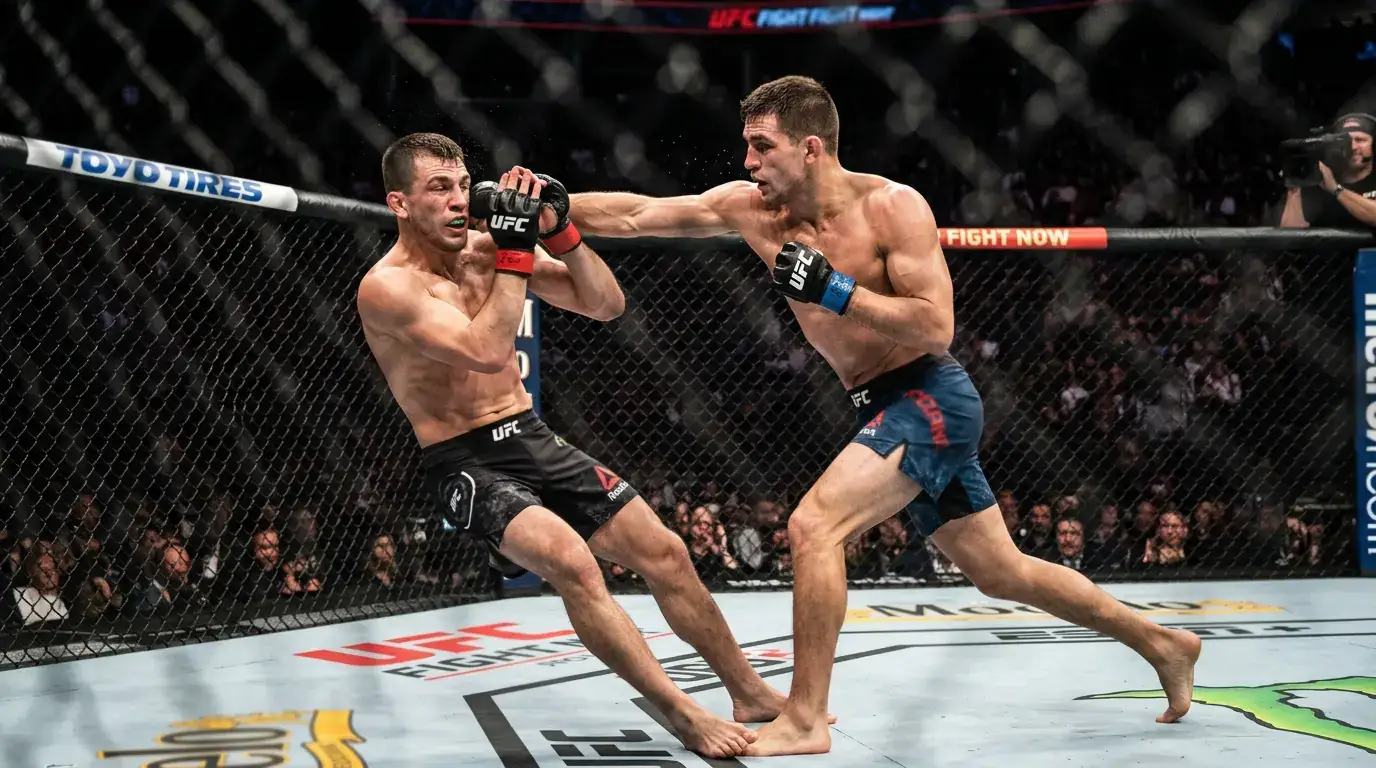
Seven or eight years ago, the UK UFC punter was a pre-fight creature. You’d price a card on the Tuesday, lock in your bets by Friday weigh-in, and settle in to watch on Saturday night with nothing to do but drink tea and shout at the television. That world is mostly gone. Roughly 74 percent of in-play betting activity in the UK is now placed from phones and tablets, and a huge chunk of that is combat-sports traffic on fight night — live moneyline swings, round-finish micro-markets, Bet Builders assembled between the weigh-in and the first bell, cash-out offers pulsing up and down as the fight unfolds.
That’s the practical landscape this guide addresses. Not “live betting as a concept” — you already know it exists — but the concrete mechanics of using in-play markets, Bet Builder combinations, and cash-out tools on UK sportsbooks the way they actually operate during a UFC fight. Where the book’s latency hides, when the cash-out offer is fair and when it’s robbing you, which same-fight combinations UK operators allow and which they block. My coverage of the underlying strategy — when to stake, how much, how to filter — lives in my UFC betting strategy guide for UK punters. Here I’m staying on the tools themselves.
How in-play UFC pricing actually works in UK apps
The first thing to understand about UFC in-play is that it’s harder for the book than football or tennis. In football the trading desk has a possession model, a shot model, and ninety minutes of continuous game-state to update against. In tennis it’s point-by-point with a clean probability tree. UFC fights can flip on a single exchange — a counter left hand in round one, a third-attempt takedown in round three — and the book’s model has to absorb that shift while a trader decides whether to suspend the market for five seconds or let it keep pricing.
The flow is roughly this. Opening in-play moneyline posts seconds after the first bell, close to the pre-fight closing line. As the fight develops, the price shifts in small steps — a fighter landing a clean combination in the opening minute might move 4/6 to 4/7. A takedown scored at minute two moves it further. A big mount position with ground-and-pound landing can collapse the underdog’s line from 2/1 to 9/2 in under thirty seconds. When a knockdown or submission attempt lands, the market almost always suspends — the book needs a trader to eyeball what just happened before the algorithm reopens pricing.
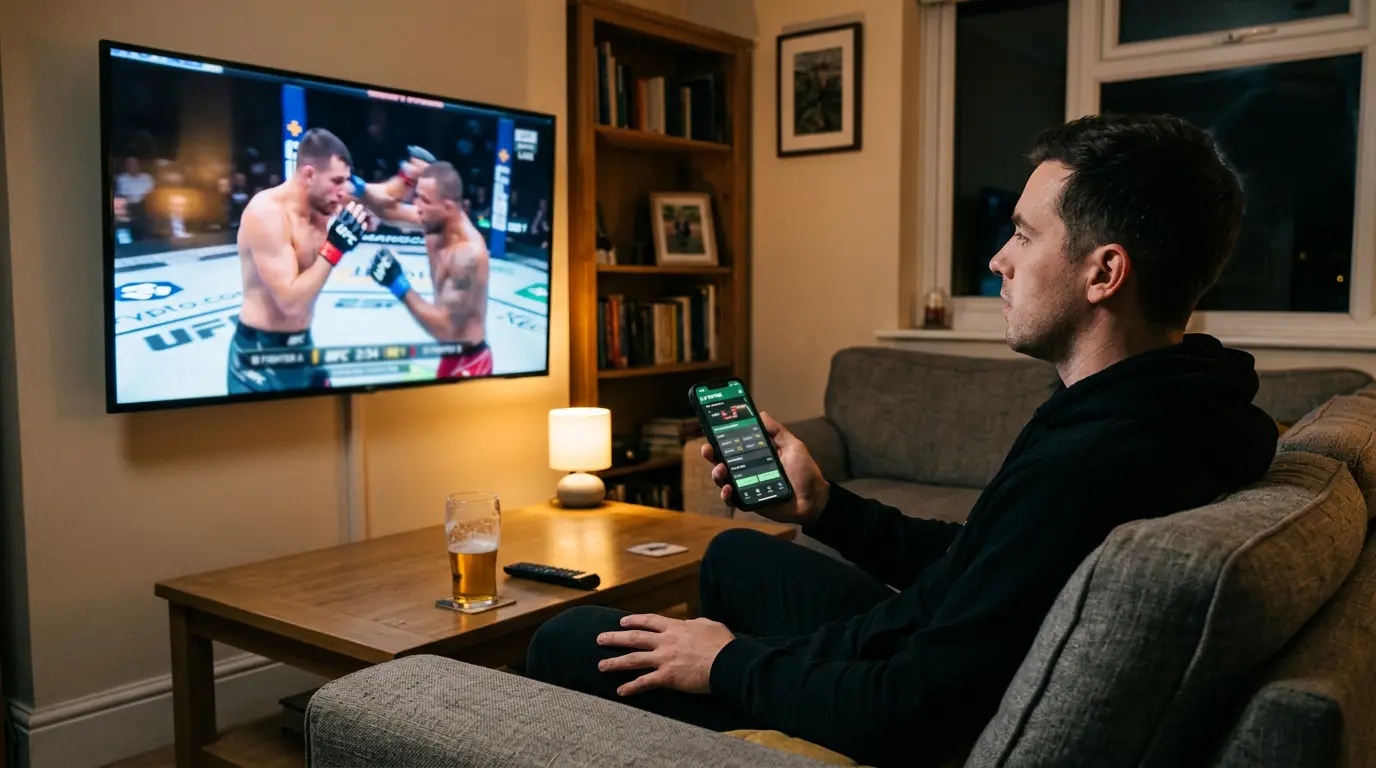
With 74 percent of UK in-play volume arriving from mobile, the book has to optimise for a specific user profile: someone watching the fight, holding a phone, tapping at an odds panel that refreshes every few seconds. That pressure is why UK operators have invested so heavily in latency — the gap between something happening in the cage and the new price arriving on your screen. Some books run sub-two-second refresh cycles on moneyline; others run five to seven seconds. That gap is where the casual in-play punter loses money: you’re betting at a price that already reflects a punch you watched five seconds ago.
Between-round breaks are the cleanest window. The one-minute between round one and round two is the period where the book’s trading desk reprices everything based on what they just saw: strikes landed, cardio read, takedown success, corner instructions. Moneyline, totals, method, and all combo markets reset. If you’ve been watching the fight and your read is different from the book’s repricing, the between-round window is where your edge is most actionable. Be quick — the window is genuinely sixty seconds.
The suspension logic catches people out. A market suspends not when the round ends but whenever the book’s model flags significant uncertainty: a referee warning, a doctor check, a scramble where one fighter almost finishes the other. Some books suspend for as little as fifteen seconds. Others keep the market dark for a full round if they’re not confident in the repricing. If you’re watching the market and you see “bet in play — unavailable”, the book is saying: we don’t know what to price this at right now. That’s usually the signal to stop trying to chase the exchange you just watched.
Bet Builder mechanics: combining legs on the same UFC fight
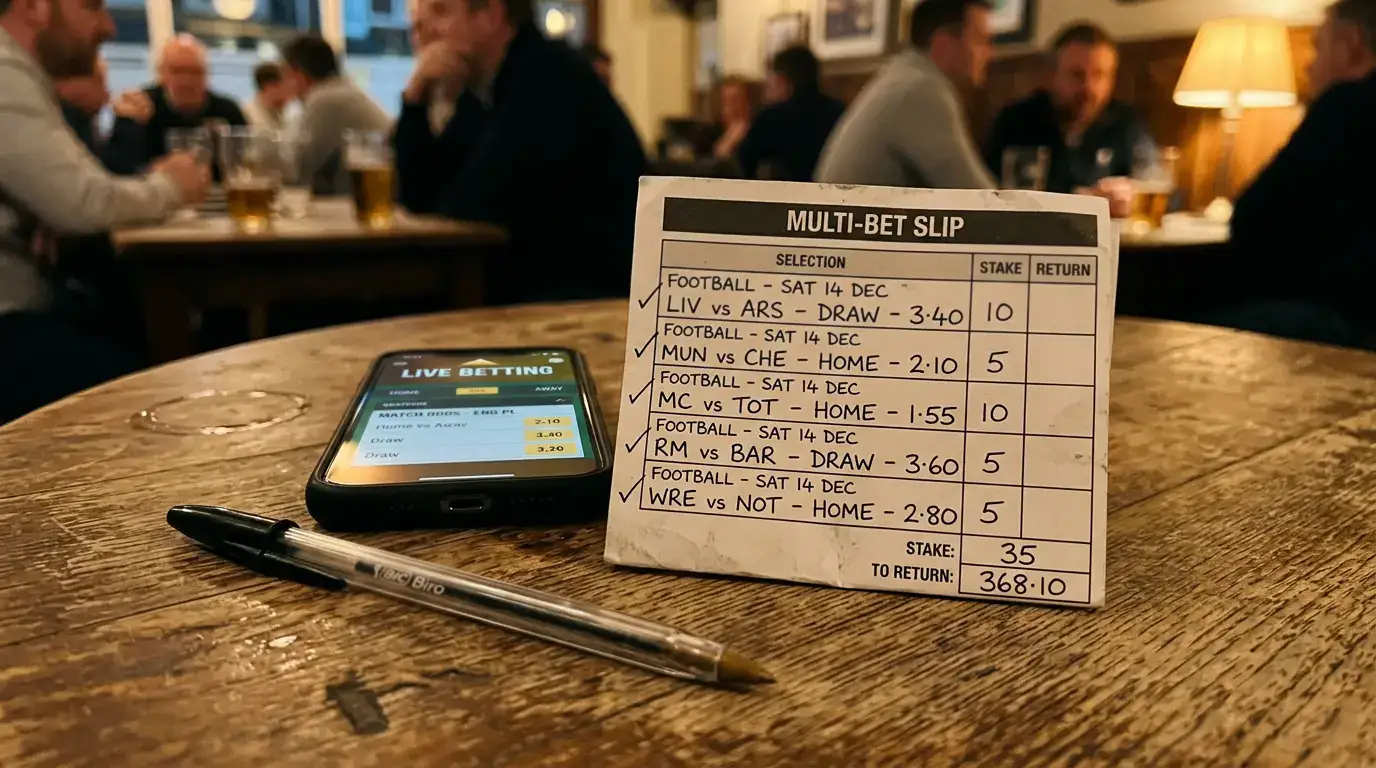
Bet Builder is how UK sportsbooks rebranded the same-fight parlay and made it the most-used combo tool on their apps. You pick two or more legs from a single fight — “Fighter A to win”, “fight to end in round two”, “method of victory KO/TKO” — and the builder quotes you a combined price. Place one slip, one payout if every leg lands.
The combined price is not a simple multiplication of the individual odds. UK books use a joint probability model that accounts for correlation between legs. On a UFC fight, “Fighter A by KO/TKO in round one” and “fight ends in round one” are obviously correlated — you can’t have the first without the second — so the builder bakes that in rather than treating the legs as independent. The result is a combined price that’s longer than either leg on its own but shorter than the product of the two, usually by three to five percent of margin.
Which legs the builder allows is the first thing to check. Most UK operators permit fighter winner, method of victory, round betting, totals, distance, and a handful of performance props in the same combo. What they usually block is contradictory pairs — you can’t select “Fighter A to win” and “fight ends in round one” and “Fighter B by submission in round one” in the same slip because the last leg contradicts the first. The builder will refuse to construct the slip and tell you which leg is the conflict. Some books also block specific highly-correlated pairs that would produce near-certain payouts on otherwise-unlikely combinations — a historic edge that books have steadily priced away.
A worked example. On a main event I was watching recently, the pre-fight moneyline on the favourite was 4/7 (decimal 1.57). Method KO/TKO for the same fighter was 11/8 (2.375). Round 1 finish was 6/1 (7.00). Built as a three-leg Bet Builder, the combined price came out at 16/1 (17.00) rather than the naive multiplication of 1.57 × 2.375 × 7.00 = 26.10. The book had priced in correlation and added its margin. Whether 16/1 is good value depends on your own estimate of the joint probability — you’re paying a premium for convenience over constructing the same position through a method-and-round combo straight line.
Boosts sit on top of Bet Builders on most UK books. A Bet Builder boost adds a fixed percentage to the combined odds — ten percent, fifteen percent, twenty percent — either as a daily promotion or unlocked when the combo hits a minimum of legs (usually three or more). The order of operations matters: the boost is applied to the final combined odds, not to each leg before they’re combined. So a three-leg builder at 16/1 with a ten percent boost settles at 17.6/1, which the book will round to the nearest displayable fraction.
My rule of thumb after a lot of testing: a two-leg Bet Builder is usually priced close to fair after margin. Three legs is where the correlation-plus-margin load starts to hurt. Four legs and up, you’re often getting a price that would barely clear a stricter expected-value check. I use the builder primarily for two-leg constructions on fights where the two events are almost independent — fighter-to-win paired with totals, say. That’s where the premium over constructing the same thing through straight markets is smallest.
Cash out: what the number really represents
Cash out is the button that appears next to your live bet slip showing a number the book will pay you right now to close the position. Tap it, the bet settles at that figure, done. The mechanic sounds simple and the maths underneath is less generous than it appears.
The cash-out offer is calculated from the current in-play price on your selection. Roughly: the book takes your original stake, multiplies by the original odds to get your potential return, then multiplies that potential return by the current implied probability, then subtracts a margin. So a £20 bet at 4/1 (potential return £100) with your fighter now trading at 1.60 in play (implied probability 62.5 percent) would mathematically offer £100 × 0.625 = £62.50. The book’s actual cash-out offer would come in lower — usually £55 to £60 — because the cash-out formula adds a second margin on top of the already-marginned in-play price.
The effective cost of taking cash out is therefore two layers of margin rather than one. You paid overround when you placed the bet. You pay overround again when you close early. That’s not necessarily a reason to refuse — sometimes locking in a guaranteed return beats the variance of playing out — but it’s a reason to understand what you’re paying for.
When cash out makes sense. First, when the live price has moved sharply in your favour and you genuinely believe you’ve been lucky rather than right. A favourite you backed at 4/6 who drops his opponent in the opening thirty seconds — the in-play price on him will plunge, and the cash-out offer will climb. If you’re honest that a knockdown doesn’t always end the fight, and you’d rather bank eighty percent of your win than risk losing it to a comeback, cash out is doing exactly what it’s designed for. Second, when a piece of information arrives after you’ve bet that changes your fundamental read — a fighter limping between rounds, a corner signalling they’ll stop the fight if another bad round happens. That’s a clean reason to take the offer and walk.
When cash out is usually a mistake. Panic cashing during an early scare before your read has actually been falsified. An underdog landing one good counter in round one doesn’t usually change the fundamental matchup; the cash-out offer will shrink, but if your pre-fight view still holds, taking the offer is just buying short-term comfort at long-term cost.
Partial cash out is a variant that lets you close part of the position. You might take half your potential return off the table and leave the other half running. The maths is exactly proportional — 50 percent partial cash out equals 50 percent of the full cash-out offer. What it buys you is a risk-shaped middle ground: you’ve guaranteed something, but you’re still live if the fight plays out your way. I use partial cash out sparingly, mostly on fights where I’m over-weighted on a single fighter and want to reduce concentration without fully exiting.
Auto cash out sets a threshold — “automatically cash out if the offer reaches £75” — and the book takes it for you the moment the trigger hits. Useful for fights you won’t be watching live. Less useful for fights you’re watching, because human judgement on fight-state beats any threshold the book lets you set.
When cash out is unavailable. The market can disappear mid-fight for the same reasons the in-play line suspends: referee warning, doctor check, knockdown, submission attempt, scramble. Your cash-out offer goes dark, usually for ten to forty-five seconds, then returns at a repriced level. That’s the book protecting itself from pricing during a moment it can’t model cleanly. It’s also a reminder that the cash-out number is the book’s price, not yours — they can withdraw it any time they decide the market’s too uncertain.
Acca insurance and odds boosts on UFC multiples
Accumulator insurance is the promo UK books use to keep casual punters betting multi-fight slips on UFC cards. The deal is straightforward on the surface: if you build an accumulator across four or more UFC fights and exactly one leg loses while the others all win, the book refunds your stake — usually as a free bet token, occasionally as cash, rarely as anything else. The phrase “one leg lets you down” has been the marketing shorthand for a decade.
The terms are where the detail lives. Minimum legs vary by operator — four, five, or six is the common range on UFC. Minimum odds per leg usually sit around evens or 4/5. Maximum refund is capped, typically £10 to £25 in token form. And the “one losing leg” rule is strict: if your acca has a voided leg (fight cancelled, opponent replaced) plus a losing leg, most books count the void as the loss and refuse the refund. If two legs lose, you get nothing, even if the second losing leg was a massive outlier.
Whether acca insurance is actually worth building around depends on your broader approach. On positive-expected-value picks, the insurance is a bonus on top of bets you’d have placed anyway — small win. On picks you’d never have made without the insurance motivating the stretch, it’s a trap; you’re betting worse slips because the promo makes it feel safer, and the free-bet token on a refund is worth roughly 70 to 80 percent of cash value because it’s usually one-use, often with minimum-odds clauses on redemption.
Free-bet token versus cash refund is a distinction UK books vary on. Cash refund is genuinely free — credited to your main balance, withdrawable. Free bet token is a promotional chip: you can only stake it (not withdraw), and typically only the winnings return to cash while the token itself is consumed. So a £10 token that wins at 2/1 returns £20 cash to your balance, not £30. If you’re weighing two books’ acca insurance offers, the cash-refund version is materially better than the free-bet token version even if the headline refund cap is identical.
Odds boosts are the cousin of acca insurance and they work very differently. A boost applies a fixed uplift to a specific pre-selected market: “Fighter A to win by KO in round one, boosted from 6/1 to 8/1 today only.” You’re getting a better price on a single selection than the normal market offers. Boosts can be genuinely valuable — the book is choosing to run at a lower margin on that specific bet to drive engagement — but they’re narrow by design. You can only use one per customer per day on most UK operators, and they’re capped at a maximum stake (usually £20 or £25 to the boosted price).
A pragmatic mix. Use boosts when they match a bet you’d place at the pre-boost price — a small amount of extra juice on picks you already like. Avoid accumulator insurance as a reason to stretch a slip across fights you haven’t researched. And read the specific clause about whether the refund is cash or token before you believe the headline.
Same-fight parlays: the Bet Builder’s older, chunkier sibling
The same-fight parlay is essentially the Bet Builder with a different label attached — multiple legs from one UFC fight, combined into a single payout. On UK books the terminology has mostly collapsed into “Bet Builder” because that’s the in-app name, but legacy operators still list same-fight parlay options in their combat-sports menu. The pricing model behind them is the same joint-probability approach, with the same correlation adjustment and the same extra margin on top of constructed legs.
Where same-fight parlays and Bet Builders diverge is in the selection universe. A Bet Builder is constrained to the legs the book’s builder UI supports — fighter winner, method, round, totals, distance, and a handful of performance props. A same-fight parlay constructed through the old-style combi menu sometimes offers a wider range, particularly on exotic markets that the builder won’t let you select. The trade-off is that the combi menu is harder to use — you’re ticking boxes in a list rather than building a visual slip — and the combined price often comes out wider because the backend doesn’t apply the builder’s modern correlation handling.
Practical advice: if the Bet Builder supports the legs you want, use it — the pricing is usually better because the builder handles correlation more accurately. Fall back to the same-fight parlay menu only when the builder can’t represent the combination you’re trying to make, typically because you want an exotic prop the builder excludes.
Correlation is the concept that governs whether a two-leg combo is priced efficiently. Positively correlated legs reinforce each other — “Fighter A to win” and “Fighter A by KO/TKO” are heavily linked. Negatively correlated legs pull against each other — “Fighter A to win” and “fight goes the distance” on a high-finish-rate fighter, say. Books charge a premium over naive multiplication roughly proportional to correlation strength.
The angle worth remembering: low-correlation same-fight combos sometimes get priced close to fair value because the book’s model can’t find a strong correlation to charge for. A “fighter to win” paired with a “takedowns over X” prop on the opposite fighter is almost independent, and the combined price often lands close to the straight-line product. Those are the combos worth looking at carefully.
Streaming UFC inside a UK sportsbook app
A UK UFC punter in 2026 has to think about broadcast rights and sportsbook rights as two separate systems that occasionally overlap. The main UFC rights-holder in the UK and Ireland has been TNT Sports since it picked up the package in spring 2013 — originally under the BT Sport branding, renewed in May 2022, and now streamed through HBO Max’s UK tier for some 2026 content alongside the traditional TNT Sports Box Office pay-per-view model. That’s where you legally watch the main events end-to-end. It’s a completely different stream from whatever your sportsbook app might offer.
What UK sportsbooks typically show in-app on UFC cards is not the main card under the TNT rights deal. It’s a mix of prelim coverage, some early-round Fight Pass content, and occasional lower-tier cards the operator has licensed independently. If you open your sportsbook app during fight week and see a UFC stream embedded in the fight page, it’s almost certainly a prelim or an early-card fight — not the headliner you came for. Some books explicitly flag what’s available; others are quieter about it, and the disappointed punter who expected the main event from their sportsbook app is a recurring story.
The qualifying conditions for in-app streaming on UK books usually require either a funded account or a live bet placed on the fight. Some operators extend streaming to any logged-in customer with verified KYC; others lock it behind a bet within the previous 24 hours. The variation is real and worth checking before the card starts, not during the walkout.
Latency against the official broadcast is the non-trivial wrinkle. The sportsbook’s in-app stream is typically three to seven seconds behind whatever feed they’re pulling from, which itself may be a few seconds behind the broadcast-centre feed. The practical upshot: if you’re watching an in-app stream, the betting markets you’re looking at are pricing against information the book’s trading desk has already absorbed — they see the fight a little ahead of you. Which is to say: watching inside the app is a perfectly fine user experience, but don’t imagine you’re betting live with any kind of information advantage. You’re a few seconds behind the house.
A handful of UK books have invested genuine product resource in combat-sports integrations over recent cycles. Partnerships with promoters have tightened the feedback loop between event operations and sportsbook product teams — better fight-page layouts, faster market repricing on rule-set edge cases, cleaner grading when a fight ends in a weird way. The partnership announcements are publicly worded; the practical benefit to you as a punter is a less frustrating app experience during fight week. Nicholas Smith, UFC’s Vice President of Global Partnerships, has talked about the bet365 relationship in terms of investment in educational content and shared product innovation — which sounds corporate until you use an app from an operator with no meaningful UFC relationship and realise how much the integration matters.
Latency, suspended markets, and why your slip says ‘price changed’
The most frustrating moment in UFC in-play betting is tapping the bet button on a price you just saw, watching the confirmation dialog flash, and reading “price has changed — please accept new price” in the same breath. It happens constantly on UK apps and it’s almost always latency doing its job as designed.
Latency in this context is the gap between an event happening in the cage and the book’s pricing engine reflecting it. The book’s trading desk sees the fight through a direct feed from the event broadcaster — low-latency, often sub-second. You see the fight through whatever stream you’re watching (TNT Sports, HBO Max, a sportsbook-integrated feed), which sits anywhere from three to ten seconds behind the direct feed. The book’s pricing moves when the event happens. You’re looking at a price that reflects what the book already knows, while you’re watching events the book has already priced around. When you tap to bet, the system checks whether the price has moved since you opened the slip — if it has, you see the “price changed” message.
Suspended markets are the deliberate version. The book’s trading desk pauses the market when an event in the cage creates genuine uncertainty about where the price should be — a knockdown, a submission attempt, a flurry the book’s model can’t cleanly evaluate. During a suspension you physically cannot place an in-play bet on that market; the button grey-outs, the odds box shows dashes, and you wait for the desk to reopen.
Average suspension duration varies by operator. Some UK books run tight suspensions — ten to fifteen seconds on routine events, thirty seconds on a knockdown — because they invest in trading staff who can evaluate quickly and reopen. Others sit dark for sixty or ninety seconds on the same event because their model needs more time. If you’ve got two accounts with different books and one keeps its markets live through the same in-cage event, it’s a signal the book has better trading infrastructure. That’s worth noting over time, because the book that reopens faster with fair repricing is the book that gives you the most live-betting optionality.
The practical lesson about latency: don’t build your live-betting strategy around reacting to events you just watched on your screen. The book’s already priced around them by the time you’re tapping. Build it around your pre-fight model and let the in-play line confirm or refute your read. Between-round breaks are the windows where your pre-fight model is still current; the book has had sixty seconds to reprice, so has your view, and neither of you is chasing stale information. In-round reactions are where the latency hurts you most.
Mobile-first betting: what the app does that the desktop doesn’t
The UK UFC punter is a phone punter. Every data point I’ve seen over the last two years points the same way: in-play volume concentrated on mobile, app usage climbing across age brackets, desktop betting increasingly residing with older users who started before smartphones ate the world. In a mid-2025 UK survey with two thousand adult respondents, 24 percent reported betting on sport online at least monthly, rising to 52 percent among 25–34-year-olds — the demographic that’s almost entirely on mobile. The big-city pockets push even higher: roughly 31 percent of adults in London and Manchester bet on sport online monthly.
Apps do things a desktop browser fundamentally can’t match. Push notifications tied to specific fight events — “favourite at 4/1 has been knocked down, live odds now 10/11” — arrive in under a second because the book controls the notification pipeline end-to-end. Biometric login (Face ID, Touch ID, Android’s equivalent) means you’re signed in and ready to bet in two seconds rather than the thirty it takes to log in through a browser. Quick-bet functionality places a stake at the current price with a single tap — useful when between-round windows are narrow, dangerous when you’re emotional about a fight turning against you.
Notifications are the feature most punters either ignore or abuse. Configured well, they give you a meaningful edge: specific price thresholds, specific fighters, specific market types. Configured badly, they buzz your phone fourteen times during a Saturday card and you end up missing the signal in the noise. My default is to turn on pre-fight line-move alerts (price move of more than five percent on any fighter I’m watching), plus weigh-in result alerts for the main card, and turn off everything else. Between-round prompts are tempting but they encourage the worst kind of reactive betting.
Quick-bet with biometric confirmation can shrink the path from decision to placed bet down to under five seconds. That’s a big deal on a product where the fight changes every thirty seconds. It’s also a big deal for punters who should be taking a breath before they stake. Every UK book lets you disable quick-bet or raise the biometric confirmation requirement; both are worth considering if you find yourself firing off slips in the heat of a round.
App ratings are a partial signal for a book’s live-betting quality. The apps with consistent four-plus-star ratings on iOS and Android over long periods tend to be the ones with better infrastructure, faster live-odds updates, and cleaner settlement when things go weird. Low ratings cluster around apps with latency issues or confusing settlement practices. It’s not a perfect proxy — review patterns reflect customer-service experience as much as product quality — but it’s worth a quick check before you commit to an operator for a card you care about.
Questions every UK live-betting punter eventually asks
Four scenarios come up across the seasons, and the answers shift slightly as UK operators tweak their product, but the core mechanics have been stable for a while. The big-city punting pattern in London and Manchester — where about 31 percent of adults bet on sport online monthly — has pushed these product questions into sharper focus because the customer base is more demanding and more willing to switch operators based on live-betting experience.
Because the book’s trading desk can’t cleanly model what the price should be during a fast-moving exchange. A scramble, a knockdown, a submission attempt, a referee warning — any event where the fight could swing decisively in the next few seconds — triggers a suspension while a human trader evaluates. The market reopens once the situation is clear, usually within fifteen to sixty seconds. Suspension isn’t a bug; it’s the book protecting itself from pricing during chaos. Yes on most UK operators, though the cash-out offer on a multi-leg builder is often grey-out during events that would ordinarily suspend the in-play market on any one leg. If any leg of your builder is live-sensitive — round-finish, method — the builder’s cash-out will tend to track the most volatile leg’s suspension pattern. Partial cash out on Bet Builders is supported on some UK books but not all; check the specific operator. It’s worth treating as a bonus on top of picks you’d place anyway, not as a reason to stretch a slip across fights you wouldn’t normally back. Insurance paid as a cash refund is meaningfully better than insurance paid as a free-bet token, which is typically worth 70 to 80 percent of cash value because of redemption restrictions. Read the specific clause before believing the headline. The specific ranking shifts across cards and I won’t make it a formal recommendation, but the pattern is consistent: books with direct promoter partnerships and dedicated combat-sports trading staff reopen markets faster and reprice more accurately after in-cage events. Look for books that keep markets live through events where other operators suspend, and note which books still have live odds between rounds. Over a few cards the pattern becomes obvious.Why does my UFC in-play market suspend during a scramble?
Can I cash out a UFC Bet Builder in the middle of a round?
Is acca insurance worth using on a UFC multiple?
Which UK sportsbook has the fastest in-play odds for UFC?
Prepared by the Best Place to bet on ufc editorial staff.