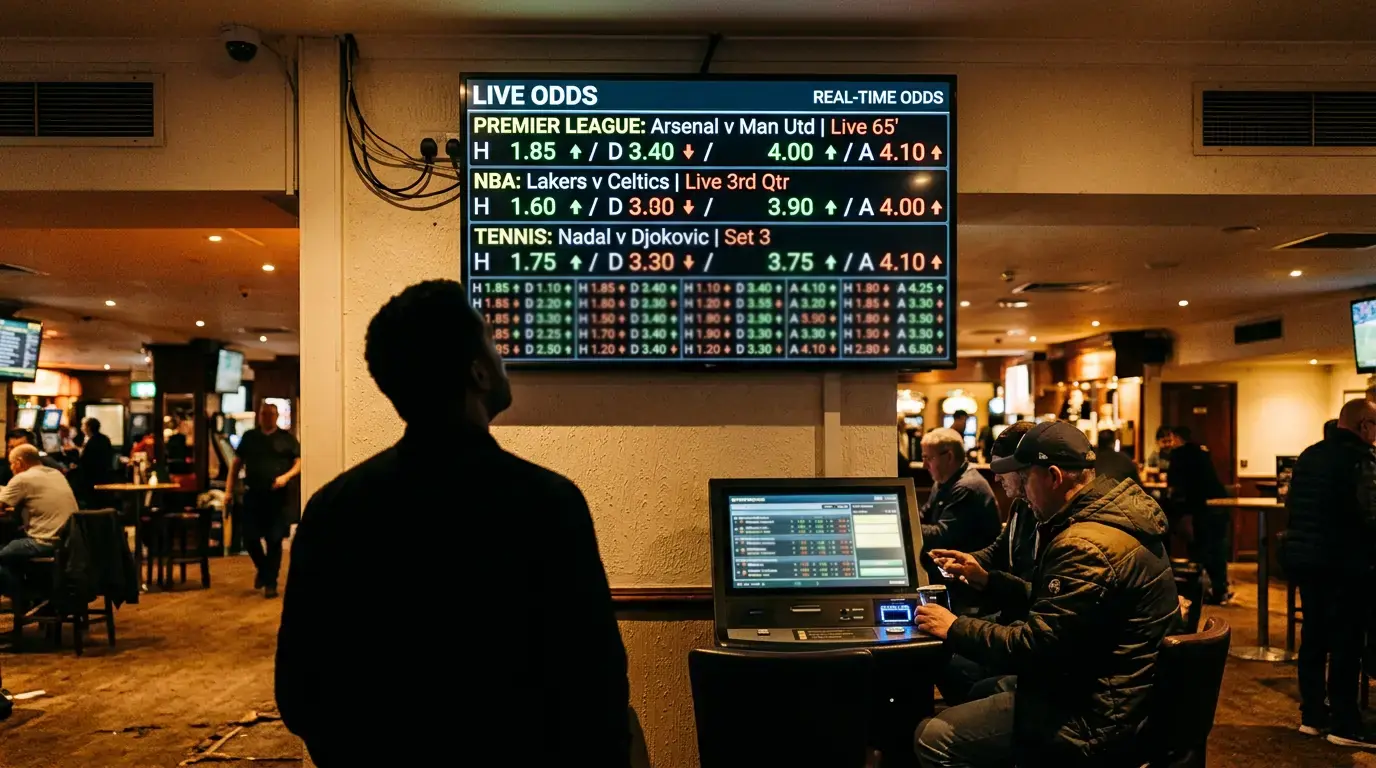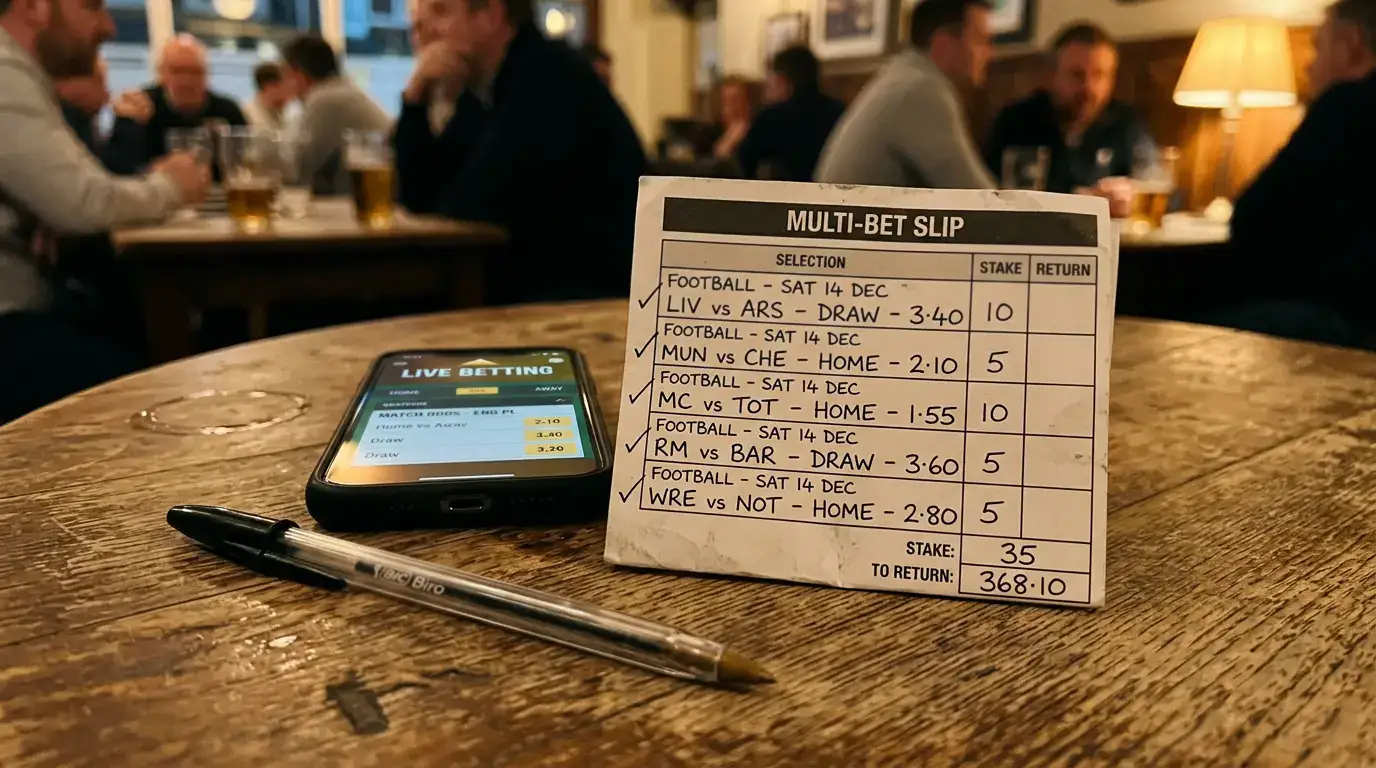
UFC Decimal Odds and Why European Books Use Them
 Available in US
Table of Contents

The format I switched to the week I started using an exchange
I spent my first five years betting UFC in pure fractions because that is what the British coupon gives you and that is what everyone around me was using. Then I opened a Betfair Exchange account for a specific fight, saw decimals by default, and the penny dropped. A decimal price is the total return on a one-unit stake. That is it. Once I got used to it, I stopped converting and started reading straight off the screen.
Decimal odds are the standard pricing format on European sportsbooks, every exchange I know of, and the default on many international books even when they also offer fractional. The format is cleaner mathematically than fractions for a simple reason — the number you see on the screen is the multiplier on your stake for the total return, stake included. No conversion, no “profit plus stake” gymnastics. Stake times price equals payout.
What I want to walk you through here is the logic behind decimal pricing, how to convert between decimal and fractional in both directions without a calculator, why exchanges specifically prefer decimal, and which UK books let you flip the display format in app settings. If you are already comfortable with fractions, decimals will take you about fifteen minutes to fully absorb.
The logic behind decimal quotes
Decimal pricing is built around total return rather than profit. A selection priced at 2.00 returns 2.00 units for every 1.00 unit staked. Your profit is 1.00 — the stake is subtracted at the end to get there. 3.50 returns 3.50 per 1.00 staked (profit of 2.50). 1.80 returns 1.80 per 1.00 (profit of 0.80).
The “includes the stake” part is the bit people trip over when they first see a decimal quote. A price of 1.91 looks scary because it is below 2.00, and you instinctively think “less than evens, not worth betting”. But 1.91 in decimal equals 10/11 in fractional — the standard pick’em price on most UK books — and it returns 1.91 units for every 1.00 staked, which is a 0.91 profit. So 1.91 is a fraction above evens in profit-to-stake terms, just not dramatically. Once you stop seeing 2.00 as a special number and start seeing it as simply “doubles your stake including the stake”, decimal prices read naturally.
A useful sanity check: decimal prices below 2.00 are odds-on (favourite), prices above 2.00 are odds-against (underdog), prices exactly at 2.00 are evens (50 per cent implied). A price of 1.25 is the same favourite as 1/4 in fractions (80 per cent implied). A price of 11.00 is the same underdog as 10/1 in fractions (about 9.1 per cent implied).
Implied probability is a one-step calculation from decimal. Divide 1 by the decimal. 1.25 gives 1/1.25 = 0.80 = 80 per cent. 3.50 gives 1/3.50 = 0.286 = 28.6 per cent. UFC underdog win rate across 2023-2024 sat at roughly 30 to 35 per cent, so a decimal price above 3.30 on a dog is worth a second look, and prices below 2.85 should be compared carefully against your own read before backing.
Converting decimal to fractional in one move
Going the other way — from decimal to fractional — takes a single step. Subtract 1 from the decimal, which gives you the profit-to-stake ratio. Then express that as a fraction.
Examples. 1.80 minus 1 is 0.80, which is 4/5 (multiply top and bottom by 5). 2.50 minus 1 is 1.50, which is 3/2 (or 6/4 in the rounded form UK books often use). 3.00 minus 1 is 2.00, which is 2/1. 11.00 minus 1 is 10.00, which is 10/1.
The awkward ones are mid-range decimals that do not reduce to clean fractions. 1.91 minus 1 is 0.91, which is closest to 10/11 — a common UK fractional price that does not reduce to a clean integer. 2.20 minus 1 is 1.20, which is 6/5 (or 24/20 if you really want to be precise, but UK books round to 6/5). 3.25 minus 1 is 2.25, which is 9/4.
You do not need to be precise to the penny in most cases. Round to the nearest commonly-used fractional denominator and you are within a few pennies on anything but the largest stakes. Where precision matters is when you are line-shopping — 1.909 on one book versus 1.910 on another is a real difference on a £1,000 stake, and that is exactly where decimal reading is quicker than converting everything back to fractions.
Why exchanges run decimal by default
Betting exchanges — Betfair being the obvious UK example, Smarkets another — price everything in decimal because exchanges are a marketplace, not a bookmaker. When you place a bet on an exchange, you are not betting against the house. You are matching a bet with another user who has taken the opposite side. The exchange takes a commission on net winnings and otherwise stays out of the transaction.
That model makes decimal a natural fit for a few reasons. Exchange orders are placed at specific prices — you can request to back a fighter at 2.50 when the current offer is 2.40, and your order sits in the queue until someone lays that price to you. Expressing that kind of limit order in fractions would be clumsy, because the next fraction up from 12/5 (2.40 in decimal) is 5/2 (2.50 in decimal) and there is nothing smoothly in between. Decimal gives you continuous pricing — 2.42, 2.44, 2.46 — which is exactly what a marketplace needs.
The second reason is symmetry. On an exchange, for every back bet there is a lay bet on the other side at the same price. A 2.50 back on Fighter A is the same as a 2.50 lay on Fighter A from the counterparty’s view. In fractions that symmetry is ugly — the lay side has to calculate liability differently for each fractional value. In decimal, liability is simply (price minus 1) times stake, which works out the same for every decimal quote on the board.
A practical consequence: if you are using a UK sportsbook for most of your betting but occasionally using an exchange for better prices on specific fights, keeping decimal in your head is much easier than flipping between systems. I did exactly that for about two months and the cognitive overhead of constant conversion was not worth the marginal edge I was chasing.
Switching the display on Bet365, William Hill, Paddy Power and the rest
Every major UK sportsbook now lets you switch the display format in settings. The exact menu path varies but the function is universal — somewhere in account preferences or display settings, you will find an option for “odds format” with at least fractional and decimal, often also American.
Bet365 sits the toggle near the account settings area on mobile and desktop. William Hill has it under preferences. Paddy Power has it in the account menu. Ladbrokes and Coral, running on the same platform, share the same toggle location. Betfair Sportsbook runs fractional by default but will switch to decimal; Betfair Exchange runs decimal and cannot switch. Most other big UK operators follow a similar pattern.
What switching actually changes: only the display. The underlying price is the same, and the payout on a winning bet is identical whether you see it as 5/2 or 3.50. So there is no hidden downside to flipping the format back and forth depending on what you are doing. I keep fractional on for casual reading of the UK coupon because British punters around me use fractional shorthand, and I flip to decimal when I am running maths on implied probability or comparing across books that price at slightly different fractional rounding.
One feature worth enabling if your book offers it: the “show both” display. A handful of UK books now offer a side-by-side display with both fractional and decimal visible on each selection. This is useful when you are still training your eye on decimal and want the fraction alongside as a cross-check. If your book only offers one format at a time, I recommend flipping to decimal for a week as a training exercise — you will stop reaching for the conversion mentally and start reading prices directly.
When the format you use actually matters
Most of the time the format you prefer is just a reading preference — the bet is the same bet. Where the format starts to matter practically: line-shopping, accumulator building, and spotting mispriced exchange orders.
Line-shopping across three UK books is faster in decimal because you are comparing two or three numbers to each other directly. 1.72 versus 1.73 versus 1.75 on the same selection is a straightforward read; 8/11 versus 4/5 versus 8/13 requires a moment of fractional conversion in your head before you know which is the best price. Over a long year of action, the cumulative benefit of always taking the top price is genuine — compounding maybe one or two per cent of expected value depending on how disciplined you are — and the faster you can read across books, the more often you actually bother.
Accumulator multiplication is cleaner in decimal too. A four-leg acca with legs priced 1.91, 2.50, 1.80, 3.25 multiplies straight across: 1.91 x 2.50 x 1.80 x 3.25 = 27.95. Multiply by your stake to get the total return. The same calculation in fractions is a nightmare of common denominators and round-off errors. If you build multiples often, decimal is not optional, it is just correct. UFC underdog champions successfully defend their belts at roughly 63 per cent according to historical data, which is exactly the kind of probability that shows up cleanly as 1.59 in decimal and awkwardly as 8/13 or thereabouts in fractions. For the wider odds picture, the UK odds explainer covers fractional, decimal and implied probability side by side.
Does a decimal quote of 1.91 include my stake or not?
Yes — a decimal quote always includes the stake. A price of 1.91 means that for every £1 you stake, your total return if the bet wins is £1.91. Your profit is 91 pence, and the original £1 stake is part of the £1.91 that gets returned. So a £10 bet at 1.91 pays out £19.10 total, which is £9.10 profit plus your £10 stake back.
Can I switch between decimal and fractional on Bet365, William Hill and Paddy Power?
Yes — every major UK sportsbook lets you change the odds format in account settings. The exact menu path varies, but the option is universal. Bet365, William Hill, Paddy Power, Ladbrokes, Coral, Betfair Sportsbook and the rest all support at least fractional and decimal, and most also support American. Betfair Exchange is the main exception — it runs decimal only and cannot be switched.
Why do UFC exchanges quote in decimal while sportsbooks default to fractional?
Because exchanges are marketplaces with continuous pricing. Exchange users place limit orders at specific prices and match with counterparties — that needs a fine-grained, continuous format that decimal provides naturally. Fractions jump in discrete steps (5/2 to 11/4 to 3/1) with nothing clean in between. Sportsbooks default to fractional in the UK purely for cultural reasons — it is what the British high street has used for a century.
Created by the ”Best Place to bet on ufc” editorial team.