UFC Implied Probability: Finding Value in the Odds
 Available in US
The mental muscle that separates serious punters from tourists
A friend of mine who runs his own trading book once told me the single most important skill in sports betting was not picking winners — it was pricing probability. Anyone with thirty minutes of fight tape can tell you who they think will win. The question that actually pays is whether the price on offer is bigger or smaller than what you think the true probability is. That is implied probability, and that is where the edge lives.
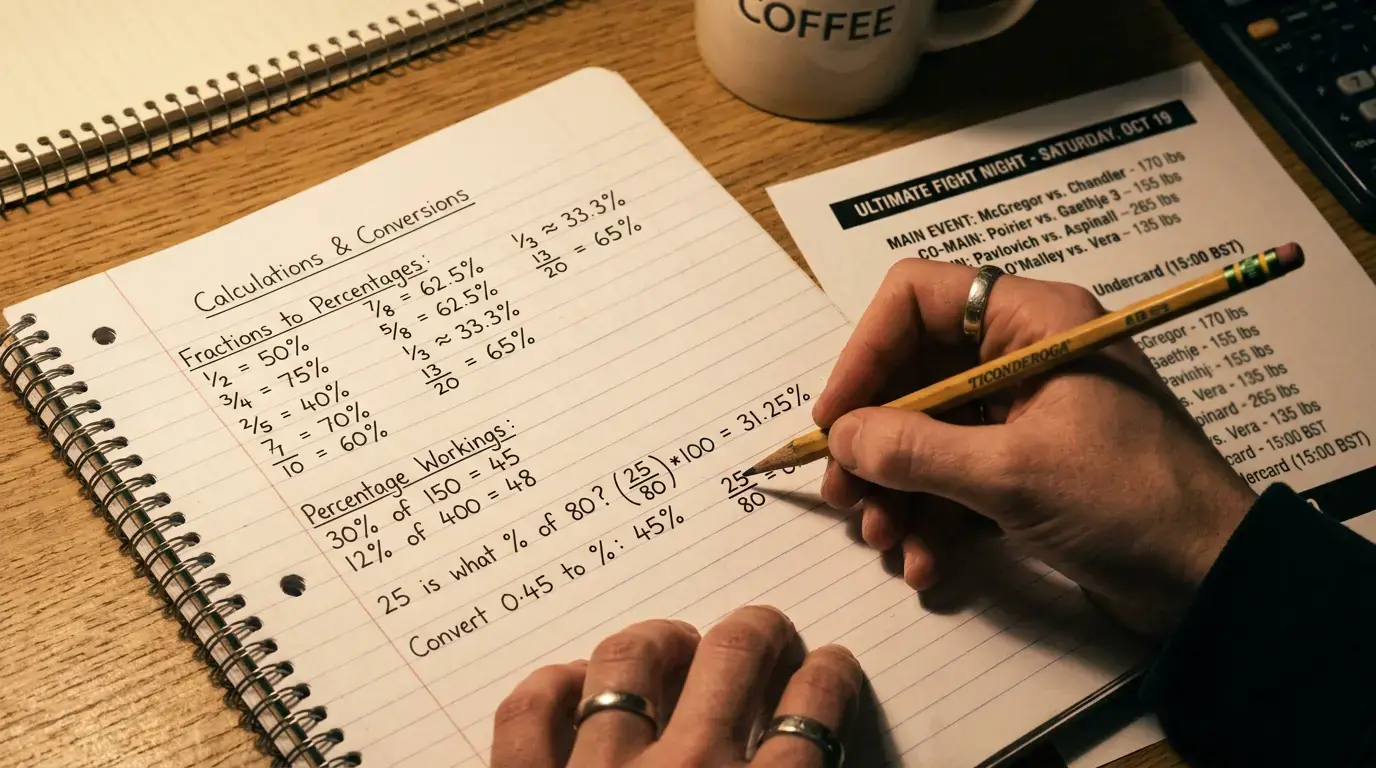
Implied probability is the percentage chance of an outcome baked into the bookmaker’s price. If a fighter is priced at 2.00 in decimal (evens, 1/1 fractional), the implied probability is exactly 50 per cent — the book thinks that bet happens half the time. If the price is 1.50 (1/2), the implied probability is 66.7 per cent. If the price is 4.00 (3/1), the implied probability is 25 per cent.
What turns this into an actual edge rather than just maths homework is doing the same calculation on your own read, comparing to the book’s implied number, and betting only when yours is meaningfully higher. If you think a fighter wins 40 per cent of the time and the book prices them as a 25 per cent shot, you have a 15-point edge and a bet worth making. If the book has them at 45 per cent and you have them at 40, the book is ahead of you and the stake is dead money. The whole game is that comparison.
Probability from decimal odds
The formula is one step. Divide 1 by the decimal odds.
1.50 implied probability is 1/1.50 = 0.667 = 66.7 per cent. 2.00 is 1/2.00 = 0.50 = 50 per cent. 3.50 is 1/3.50 = 0.286 = 28.6 per cent. 11.00 is 1/11.00 = 0.091 = 9.1 per cent.
Some shortcuts worth memorising. Prices near 2.00 are near 50 per cent. Prices near 1.50 are near 67 per cent. Prices near 3.00 are near 33 per cent. Prices near 4.00 are near 25 per cent. Once you have those anchor points, any price in between reads intuitively — you know 1.80 is a bit above 55 per cent because it sits between 1.50 and 2.00, and you can nail the exact number with the division when you need to be precise.
What those percentages mean practically: they are the book’s probability estimate with the margin baked in. A genuine 55 per cent chance priced fairly would be at 1.818 in decimal. If the book offers 1.80, they are saying the probability is at least 55.6 per cent in their view — slightly above the fair 55 per cent, because the book needs a couple of points of edge for the business to work. That edge is the overround, and we will come to it in a moment.
Probability from fractional odds
A bit more fiddly but the logic is identical. Add the two numbers together, then divide the bottom by the total.
5/2: add 5 + 2 = 7. Divide 2 (the bottom) by 7 = 0.286 = 28.6 per cent. 4/5: add 4 + 5 = 9. Divide 5 by 9 = 0.556 = 55.6 per cent. 1/4: add 1 + 4 = 5. Divide 4 by 5 = 0.80 = 80 per cent. Evens (1/1): add 1 + 1 = 2. Divide 1 by 2 = 0.50 = 50 per cent.
If fractional feels clunky, convert to decimal first — divide top by bottom and add 1 — and use the simpler decimal formula from there. Both produce identical answers. I personally run implied probability off decimal because the single-step division is faster, but fractional works perfectly well once you internalise the “bottom over total” trick.
A concrete example from modern UFC. Say Tom Aspinall is priced 1/4 to defend the heavyweight title in his next fight. That is 80 per cent implied probability. You watch the tape on the challenger, you look at Aspinall’s previous defences, you factor in finish rate and durability — if you think the genuine probability is 85 per cent, there is a five-point edge and the bet is worth making at scale. If you think it is 75 per cent, the price is bleeding expected value even though Aspinall will probably win.
Stripping the overround
Here is where it gets interesting. A two-way market should sum to exactly 100 per cent in probability if there were no bookmaker margin. Real coupons do not sum to 100 per cent — they sum to 102, 104, sometimes 108 per cent. The amount over 100 per cent is the overround, and it is the bookmaker’s edge on the market.
Take a pick’em UFC fight. Fighter A at 10/11, Fighter B at 10/11. Each side in implied probability is 11/21 = 52.4 per cent. Add them: 104.8 per cent. The book is holding 4.8 per cent of margin across both sides. Your implied probability on either side is four and a bit per cent too high relative to the book’s actual view of a true 50/50 — the book is giving you a 52.4 per cent reading on something it genuinely thinks is 50 per cent.
Stripping the overround means normalising the probabilities to sum back to 100 per cent. You divide each side’s implied probability by the total overround percentage. In the pick’em example, 52.4 per cent divided by 1.048 = 50.0 per cent. Same on the other side. Now you have the book’s “true” view — both fighters at exactly 50 per cent in the book’s model, with the 4.8 per cent margin stripped out.
Why this matters: to tell whether you have a real edge, you need to compare your probability estimate to the book’s unmargined view, not to the raw implied probability you read off the coupon. If you think the fighter at 10/11 is genuinely a 55 per cent shot, the raw implied probability (52.4 per cent) suggests you have a 2.6-point edge. The unmargined view (50 per cent) shows you actually have a full 5-point edge. The overround was hiding half your edge. Over a long betting year that difference is the difference between grinding out a small profit and posting a clearly positive return.
Spotting a genuine value bet
A value bet is one where your probability estimate exceeds the book’s implied probability by enough to cover margin, variance and the long-term edge you need to grow the bankroll. Practical thresholds vary but a 3 to 5 per cent edge is the common floor — smaller than that and the variance drowns the signal.
UFC underdog win rate across 2023-2024 was in the 30 to 35 per cent range on the moneyline. That means a typical underdog at 3/1 (25 per cent implied) against a typical favourite is already sitting at a mild edge before you have done any analysis, just from base rates. Which is why “always bet the underdog” works as a low-sample strategy and fails as a high-sample one — the underdog win rate is pulled up by specific categories of dog (heavyweight sluggers, comeback veterans, stylistic upsets) that you have to actually identify, not just assume.
The framework I run on every fight I seriously consider. Step one: estimate my own probability on the outcome, ideally expressed as a percentage I can defend in conversation. Step two: convert the book’s price to implied probability. Step three: strip the overround. Step four: compare my estimate to the unmargined book number. Step five: if my estimate is at least 3 per cent higher, the bet is live; if it is lower or within 3 per cent, it is not.
The uncomfortable bit of this framework is that it forces you to pass on most fights. If you run it honestly, you will skip seven or eight bets out of ten where you thought you had a read — because once you put a number on your read and compare it to the book, the edge often evaporates. That is the point. A value-hunting bettor who skips 75 per cent of potential bets and bets only the 25 per cent where the edge is clear will out-perform the same bettor who bets everything. UFC favourites priced between -400 and -900 win 88 to 93 per cent of the time, so short-price favourite markets are almost always correctly priced and offer little value. The edges live in the middle of the card, not on the headline acts.
The bit nobody tells you about probability estimates
Your probability estimate needs to come from somewhere. If you are pulling a number out of the air — “I think he wins 60 per cent of the time because I like the way he walks to the cage” — that is not an estimate, that is a feeling dressed up as a number. The comparison with the book’s probability is useful only if your number is actually grounded in something.
What grounds an estimate: historical data on similar matchups, tape on how the specific stylistic clash has played out before, base rates for the weight class and finish profile, and adjustments for context (layoffs, weight misses, short-notice changes). You do not need a proprietary model to do this, but you do need to be disciplined about where your probability estimate is coming from, and you need to be willing to mark it down when the evidence is thin.
The one other trap worth flagging: “if my probability is 55 per cent, every bet at a price implying less than 55 per cent is +EV” is strictly true, but practically you want a buffer because your own estimate has error bars. Demand a clear margin between your estimate and the book’s — 3 to 5 per cent is a reasonable default — and the bets you actually take will be the ones where you are right more often than you are wrong. For the wider framing of how implied probability sits alongside the UK odds formats, the odds explainer pulls it all together.
How do I calculate the implied probability of a UFC favourite at -200?
Convert to decimal first. American -200 is the same as 1.50 in decimal (or 1/2 in fractions). Then divide 1 by the decimal: 1/1.50 = 0.667, which is 66.7 per cent implied probability. That is the book’s view of the fighter’s chance before you strip the overround. If you want the book’s unmargined estimate, divide the 66.7 per cent by the overround total across both sides of the market.
What does ‘stripping the overround’ mean in practice on a two-way market?
It means normalising the two sides of a market so they sum to 100 per cent instead of the 103-108 per cent you actually see on the coupon. You divide each side’s implied probability by the total of both sides. The result is the book’s ‘true’ view of each fighter with the margin removed. That is the number you should compare your own probability estimate against when you are hunting for value.
Is a UFC bet with 55 per cent true probability always +EV?
Only if the price offered implies less than 55 per cent. A price of 1.80 in decimal implies 55.6 per cent, so betting at 1.80 on a genuinely 55 per cent shot is slightly -EV once the book’s margin is factored in. A price of 1.90 implies 52.6 per cent — at that price the 55 per cent shot has a real edge. The rule is: compare the unmargined implied probability to your own estimate, and demand at least a few per cent of edge before betting.
Written by the editors at Best Place to bet on ufc.