UFC Total Rounds Over/Under Betting: A UK Primer
 Available in US
Table of Contents
The bet I wish someone had explained to me properly on day one
I remember the first time I placed an “over 2.5 rounds” bet on a UFC fight. I had watched enough football to think I knew what 2.5 meant — it meant the match needed to finish with three or more goals. So when the UFC fight I had backed was stopped at 1:58 of round 3, I thought I had won. I had not. I lost the bet by two seconds.
Over/under rounds is the UFC totals market. You are not picking who wins. You are picking whether the fight lasts longer or shorter than a threshold set by the bookmaker. The standard threshold on three-round cards is 2.5, which sounds like it should mean “two and a half rounds”. It does not. It means exactly 2:30 of round 3 — the midpoint of that round — and the UK convention for this is called the 2:30 rule. Anything before that mark is an under. Anything after — including a distance decision — is an over.
The market looks innocent. It prices out at something close to evens, because the book has done the maths on where the line needs to sit for roughly half of fights to finish on each side. The innocence is the trap. Most casual punters assume the threshold works like football halves, and most of them find out the hard way it does not.
What over/under really means on a UFC coupon
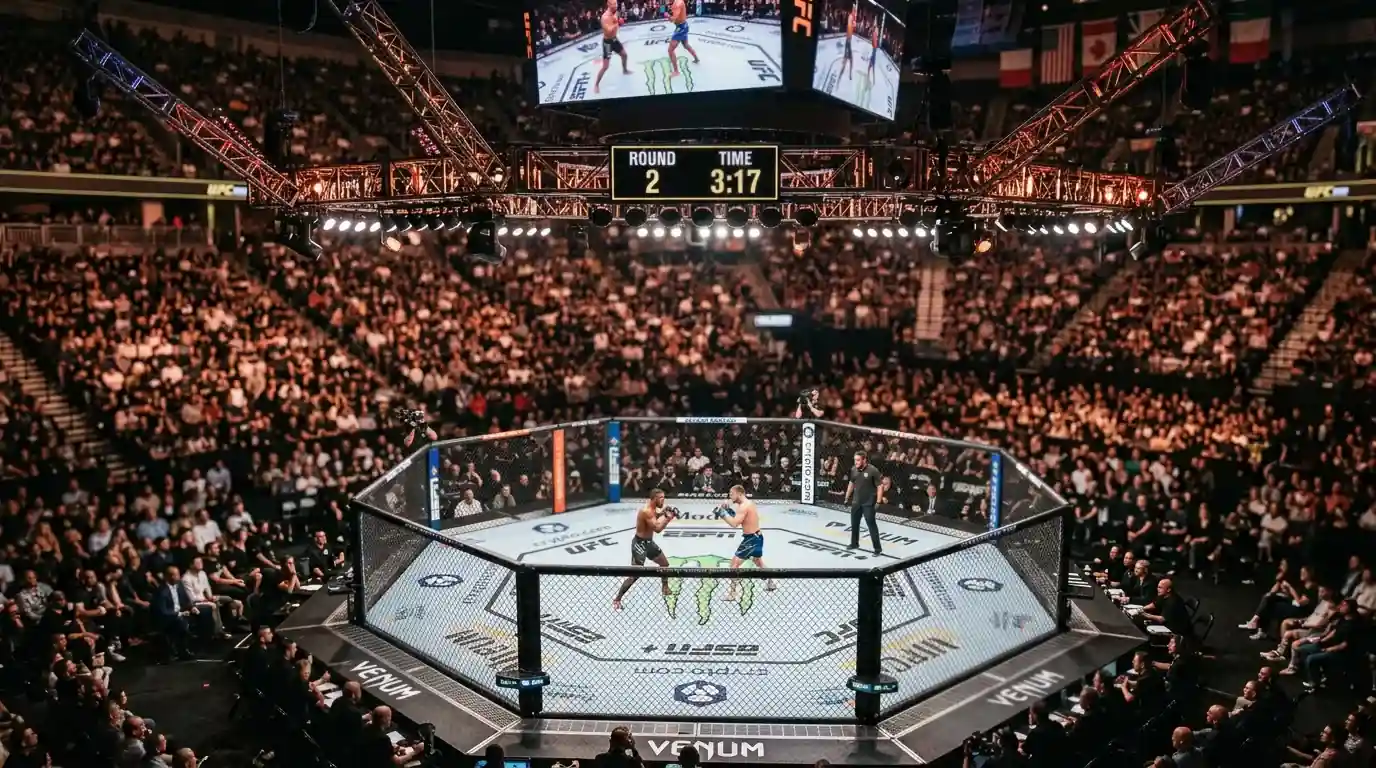
The core rule. A UFC round is five minutes long. “Over 2.5 rounds” means the fight must pass the 2:30 mark of round 3. Exactly 2:30.00 does not settle the over — the fight needs to tick into the next second. In practice, referees and timekeepers do not pause at 2:30, so the distinction only matters when a finish comes within a second or two of the threshold, which is rare but not unknown.
If the fight is finished before 2:30 of round 3, the under wins. If the fight continues past 2:30 of round 3, or goes the distance, the over wins. A fight ending exactly at the 2:30 mark — very rare but it has happened, typically from a doctor stoppage between rounds — settles as an over on most UK coupons, because the end of round 2 is technically the completion of 10:00 of action, which is past the 2:30 third-round threshold. Read the book’s rules to be sure.
On championship and main event fights (five rounds), the standard line shifts. Books usually offer 1.5, 2.5, 3.5 and 4.5 rounds as individual lines. “Over 4.5 rounds” means the fight must pass the 2:30 mark of round 5. “Over 3.5” is the 2:30 mark of round 4, and so on. The pricing on the main total (usually 4.5 on a five-rounder) is where the book puts most of its margin; the alternates further from the central line carry wider margin still.
A no contest voids totals bets and refunds the stakes. A disqualification settles the totals where the fight ended — if a DQ comes at 3:00 of round 2, the under wins on the 2.5 threshold, because the fight ended before the 2:30-of-round-3 mark. A draw settles on the distance — if the fight went the full three rounds to a draw on the scorecards, the over wins on 2.5.
Three-round totals: the honest maths
On a standard three-round card, the only totals line most books offer is the central 2.5 rounds line. Both sides usually price close to evens, maybe 10/11 or 5/6 each way, with the book’s margin tucked into the small gap. The implied probability on each side is therefore roughly 50 per cent with a few points of juice shaved off.
The honest read of the 2.5 line: the fight needs to make it at least halfway through round 3 for the over to land. In practice, across modern UFC data, roughly half of three-round fights finish before that mark and half after, which is why the pricing sits where it does. But the average hides the distribution. Fights with two well-matched grapplers tend to go long. Fights with a heavy finisher against a weak chin tend to go short. The book will push the line marginally if the matchup is clearly biased, but usually not by enough to kill the value on one side.
When I read a three-round totals market, the question I ask is not “will this fight go the distance?” — that is the distance line, a separate market on most coupons. The question is “will this fight reach at least the midpoint of round 3?” Those are subtly different questions. A fight can land on the over by ending at 3:00 of round 3 via TKO, which is not a distance outcome but is still an over on the 2.5 line.
Five-round totals and how the main event changes things
On five-round main events and title fights, you get four totals lines on most UK coupons. 1.5, 2.5, 3.5, 4.5 — each with its own over and under prices. The distribution changes dramatically from the three-round picture.
Under 1.5 is a round 1 finish bet in disguise. It settles only if the fight ends before 2:30 of round 2. That is a short window — essentially the entirety of round 1 plus half of round 2 — which is why the under side of the 1.5 line prices out long. Typical pricing is 3/1 to 5/1 depending on the finisher profile.
Over 4.5 is the distance bet for a five-rounder. The fight has to pass 2:30 of round 5, which in practice means going the full distance or being stopped in the final two and a half minutes (rare). Between two durable, well-conditioned championship-level fighters, this line can get as short as 4/6, which is the book’s way of telling you it expects a full twenty-five minutes.
The middle lines — 2.5 and 3.5 — are where casual action tends to concentrate and where the book usually has the most confident pricing. 2.5 means the fight reaches the 2:30 mark of round 3. 3.5 means it reaches the 2:30 mark of round 4. These are the lines to watch when one fighter is a known finisher and the other has never been stopped — the asymmetry shows up clearly in the pricing spread.
Alternate lines and the value they unlock
A handful of UK books offer alternate totals — 1.5, 3.5 and so on — even on three-round cards. The thinking is simple: the 2.5 central line prices close to evens, which is useful if you think the fight goes close to the wire but useless if you are confident it ends quickly or grinds to a draw.
If you genuinely think a fight ends in round 1, “under 1.5” on a three-round card pays at roughly 3/1 or longer depending on the book, because the under only wins if the fight ends before 2:30 of round 2. That is a much punchier payout than the 10/11 you would get on the 2.5 under, and it prices your conviction accurately. In 2023-2024, UFC underdog win rate across the board sat in the 30 to 35 per cent range — similar pricing logic applies to how far off consensus the book lets you push before charging extra margin.
The trade-off on alternates: the book carries more margin on lines further from the central total. A 2.5 line might have a 4 per cent overround. The 1.5 line on the same fight might have 6 or 7 per cent margin, and the 3.5 line (rare on three-rounders) even more. You pay for the longer price in two ways — the expected hit rate is lower, and the book takes a bigger cut on each side.
Where alternates pay off is on fights with extreme finish profiles. A heavyweight banger against a glass chin, under 1.5 is often the correct read and the price is fat. Two flyweights with a combined four finishes in forty fights, over 2.5 is routine but the juice on the distance line is sharper value if the book offers it. Pick the right line for the read; do not default to the central one because it is listed first.
Reading the movement between open and fight-night
UFC totals lines move more than you might expect between the opening price and fight-night. The 2.5 line may open at 10/11 each way on a Monday and be trading at 5/6 under, 11/10 over by Saturday. Sometimes the move tracks the weigh-in — a fighter missing weight is often worse conditioned and more likely to gas into a decision, which pushes the over. Sometimes it is pure volume on one side that forces the book to rebalance. Reading the reason matters more than reading the direction.
What I do before I stake on a totals line is check the line movement since open, see which way sharp money appears to be going if I have access to a line-tracker, and ask whether the story makes sense. If the line is moving towards the over and neither fighter has a relevant injury or cut story, it is probably a volume move rather than a sharp one, and I am happy to take the under at the shortened price if that was my read anyway. If it is moving towards the under and there is a public cut concern or a rumoured injury, I want to understand whether that is already priced in before I touch either side.
Totals is a market I dip into selectively, not every card. When the read is strong on pace and durability — and specifically when it is stronger than my read on who wins — totals gives me a cleaner expression of the view than trying to pick a winner. For the fuller picture of how this sits alongside method of victory and round betting, the full UK markets handbook ties it together.
Does over 2.5 rounds mean the fight needs to hit round three?
It needs to pass the 2:30 mark of round three. The 2.5 line is a half-round threshold, and in UFC a half round is 2:30 — the midpoint of the round. A fight stopped at 2:00 of round three is an under. A fight stopped at 3:00 of round three is an over. A decision after three full rounds is an over. The detail matters, and has cost plenty of casual punters a bet they thought they had won.
How do alternate UFC totals change the payout on a short finish?
They widen the payout significantly. An under 1.5 line — fight must end before 2:30 of round two — pays roughly 3/1 or longer on a three-round card, compared with about 10/11 on the under 2.5. The trade-off is that the book bakes more margin into alternate lines, so you are both taking a longer-odds bet and paying a bigger cut. Value lives there only if your read on the finish window is genuine.
When do UK books move the total between open and fight-night?
Most commonly on news — a weigh-in miss (which tends to push the over, because gassy fighters go further into decisions), a confirmed injury, a rumoured cardio problem. Also on volume: if one side draws heavy money, the book shortens that side to rebalance. The useful exercise is asking why the move happened before betting into it, not just which direction it went.
Created by the ”Best Place to bet on ufc” editorial team.