
UFC Acca Insurance and Odds Boosts in the UK
 Available in US
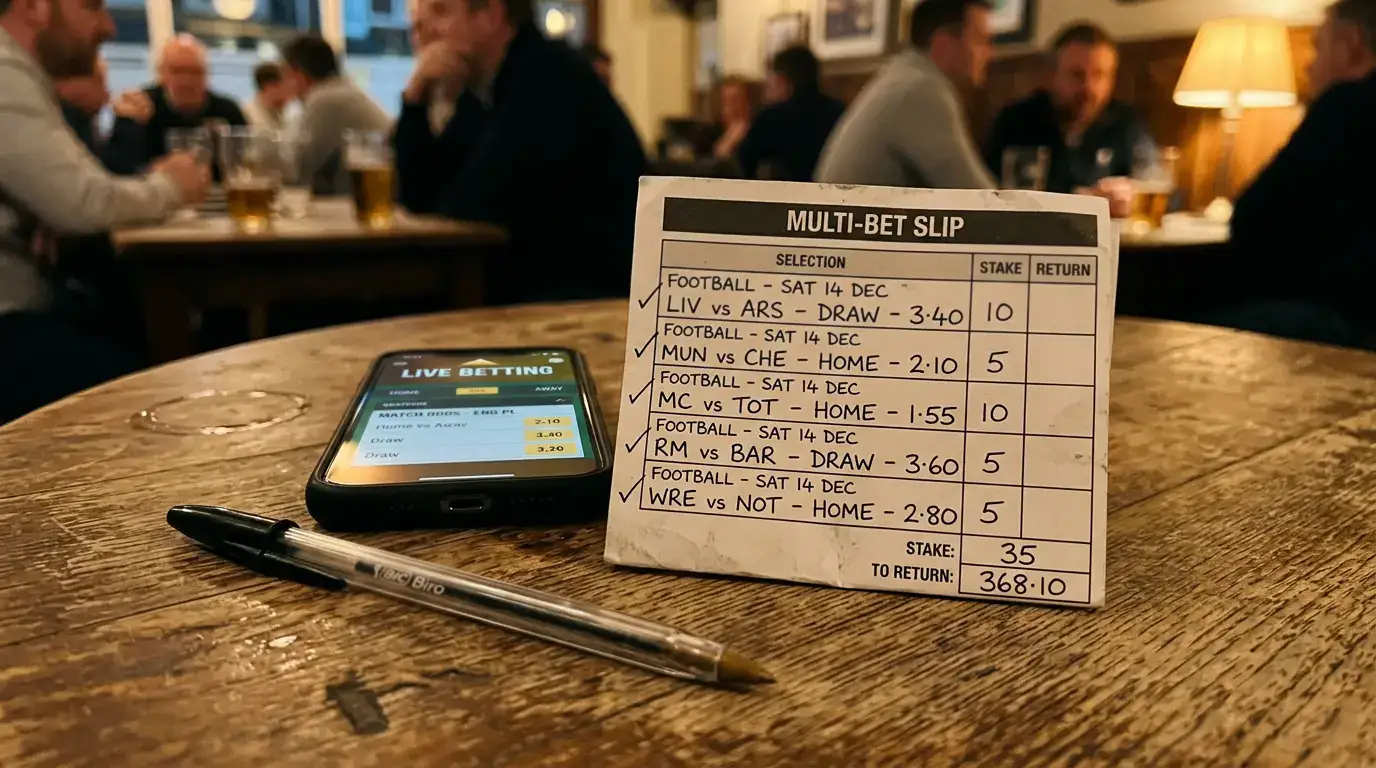
The promotion that looks like a safety net but sometimes is not
A reader sent me a message a while back asking why his four-leg UFC acca had not been refunded when one of his picks lost. He was sure his book ran “acca insurance” and that one-leg-down meant stake back. He was right about the book offering the promotion. He was wrong about what the promotion actually covered — the acca he had built had three UFC legs plus one prelim boxing leg, and the insurance only triggered on pure-football multiples. The fine print got him.
Acca insurance is the promotion where a book refunds your stake (as cash or as a free bet) if exactly one leg of your qualifying accumulator loses and every other leg wins. The logic is simple marketing: the “one that got away” feeling is a very UK betting experience, and books offer the refund as a balm to keep you coming back. The devil is entirely in what qualifies.
What I want to work through is how acca insurance actually triggers on UFC multiples, the distinction between a cash refund and a free-bet token, where odds boosts fit alongside the insurance, and the conditions you need to clear before the promotion is worth chasing.
How acca insurance triggers on a qualifying bet
The standard UK acca insurance formula. You place a multi-leg accumulator on selected markets. Every leg needs to be at minimum odds (usually 1/4 or 1/2 on each leg). The total number of legs needs to hit a minimum (4 is typical, sometimes 5). Every leg but one must settle as a winner; the one losing leg must be the only failure. If all those conditions clear, the book refunds your stake, usually up to a cap.
Most UK UFC-compatible acca insurance promotions cap the refund at £10, £25 or £50. Stake £100 on a five-leg acca, have one leg let you down, and you get back £25 (or whatever the cap is) — not the full £100. The cap is there partly to limit the book’s exposure and partly because the promotion is aimed at casual punters with modest stakes.
What qualifies as a “leg” is where UFC punters trip up. On some books, “acca insurance” only applies to accas built from eligible sports — typically football, horse racing and sometimes tennis. UFC may be explicitly excluded. On other books, UFC qualifies but only if every leg on the acca is a UFC selection. On a third bucket of books, UFC qualifies as long as it is one of the included sports and the acca has no disqualifying selections like sports outside the promotion’s scope.
Read the terms. It takes three minutes and it tells you whether the insurance actually applies to the bet you are about to place. Most casual acca insurance claims fail not because the user was unlucky but because the user did not check the eligibility of the specific sport mix before placing the bet.
Free-bet refund versus cash refund
Two payout mechanisms. A cash refund pays your stake back as withdrawable cash — you can pull it out of your account the moment it lands. A free-bet refund pays your stake as a token you can only use on a future bet, with its own terms (minimum odds to use it, markets where it is valid, expiry date).
Most UK UFC acca insurance promotions refund as a free bet, not as cash. The free bet is how the book keeps you in the ecosystem — you have to use the token to realise any value from the refund, and to use it you have to place another bet, which the book hopes you will lose (or at least win with the same margin they take on every other bet).
The value of a free bet is not equal to its face value. A £25 free bet is not worth £25 in cash. The stake on a free bet does not return with your winnings — you get the profit, not the stake. A £25 free bet used on a 3/1 selection returns £75 profit if it wins; the £25 stake is swallowed by the book. Compare to placing the £25 in cash: same 3/1 selection returns £100 total, which is £75 profit plus £25 stake. So the free bet is worth roughly 75 per cent to 80 per cent of its face value in realistic use.
Some books do offer cash acca insurance on selected promotions. Those are usually time-limited, sport-specific, and structured as high-profile promotions around big cards. They are strictly more valuable than free-bet insurance, so if you are stacking UFC accas regularly and you have a choice of books, the cash variant is genuinely worth preferring.
Odds boosts on UFC multiples
Separate promotion, often running alongside acca insurance. Odds boosts uplift the combined price of qualifying accumulators by a percentage that scales with the number of legs. A common structure: 5 per cent boost on 3-leg accas, 10 per cent on 4-leg, 20 per cent on 5-leg, 50 per cent on 8-leg or more. The boost applies to the combined price, not to individual legs.
Example. You build a 4-leg UFC acca with combined fractional odds of 8/1 (9.00 decimal, 11.1 per cent implied). The book’s boost adds 10 per cent, taking the combined price to 8.8/1 or thereabouts. On a £10 stake, the difference is £10 x 8 = £80 profit without boost versus £10 x 8.8 = £88 profit with boost. Modest in absolute terms, but real value on bets that actually settle.
Stake caps apply here too. Most UK odds-boost promotions on accas cap the boosted portion at £25 or £50 stake — bet more than that and the excess settles at the original, unboosted price. Size to the cap if the boost is worth having.
Minimum-legs requirements also apply to boosts. A 3-leg acca might not qualify for any boost, or might qualify for a small one. The economies scale upwards: the more legs you build, the bigger the boost percentage, because the book knows longer accas settle less often and it can afford to offer a bigger cosmetic uplift.
What boosts do not do: make a bad acca good. If the underlying legs are not value on their own, stacking them with a 20 per cent boost does not rescue the expected value. The boost is marketing gravy on top of a bet that needs to be worth making for its own sake. UFC favourites at -400 to -900 win 88 to 93 per cent individually, which sounds like a freeroll until you realise stacking four of them still only pays about even money — the boost at that level is cosmetic, not transformative.
Conditions and minimum-legs small print
A run through the common conditions on UK acca insurance and boost promotions. These vary book to book but the categories recur.
Minimum odds per leg. Usually 1/4 or 1/2. Selections shorter than the minimum do not count towards leg count or insurance eligibility. Stacking four 1/5 favourites together might feel like a safe acca — it is not eligible for insurance on most books because the legs are all below the 1/4 threshold.
Sport eligibility. Some promotions are football-only. Some include football plus racing. Some include UFC as part of a combat sports bucket. Some run combat-sports-only promotions specifically during big fight weekends. Check the list.
Accumulator type. Acca insurance on standard multiples is not the same as on system bets (Trixie, Yankee, Lucky 15). Most insurance promotions cover straight multiples only — system bets are excluded because the payout structure is already layered.
Stake caps. Already covered, but worth repeating: the refund cap and the boost cap are the two numbers that most affect how much value you actually extract.
Time windows. Some promotions are perpetual; others are only active during specific promotional windows (“Every Saturday”, “For the next three UFC PPV weekends”). Place the bet inside the window or it does not qualify.
Settlement clauses. What happens if a leg voids (opponent withdraws and fight is pulled)? Most books treat voided legs as winners for insurance purposes, reducing the effective leg count by one. Some treat them as winners for acca-pricing purposes but as a failure for insurance triggering. Read.
Account conditions. Some promotions are new-customer-only or restricted to accounts that have not used the promotion recently. Repeat usage caps are common.
When I build UFC accas with these promotions in mind
My approach. Acca insurance is a nice to have, not a reason to bet. If I would build a given UFC acca anyway because my reads on the individual fights are strong enough, a book that offers insurance on the same bet is marginally preferable. If I am building an acca specifically to chase the insurance refund, I am almost always betting worse than I would otherwise bet, because the insurance trigger conditions bias me towards bigger-odds legs (to hit minimum odds thresholds) and more legs (to qualify for boosts and insurance).
Across 2024-25, UK sportsbook revenue grew with remote GGY up 13.1 per cent to £7.8 billion. The promotions fuelling some of that growth are real, but they do not change the underlying maths. A UFC acca is positive-EV only if every leg is positive-EV on its own before any promotion. Insurance takes the edge off the variance; boosts add a small uplift. Neither rescues a bad selection. For the wider picture on how accas sit with live betting, Bet Builder and cash-out, the UK live betting hub covers the full toolkit.
How many UFC legs do I need for acca insurance to kick in?
Minimum four legs on most UK books, though some extend insurance down to three legs on specific promotions and others require five. Each leg usually needs to clear a minimum-odds threshold of 1/4 or 1/2, and selections shorter than the threshold do not count toward the leg count. Check the specific promotion’s terms because the exact numbers move — and because UFC eligibility varies too, with some promotions covering only football or only football plus racing.
Is a stake refund paid as cash or as a bonus token?
Usually as a free-bet token on UK UFC acca insurance promotions, not as cash. The token is worth roughly 75 to 80 per cent of its face value in realistic use because the stake does not return with your winnings — a £25 free bet used on a 3/1 selection pays out £75 profit rather than the £100 total that a £25 cash bet would produce. A small number of promotions pay cash refunds, which are strictly more valuable.
Do boosts on UFC multiples ever eat into the insurance clause?
Not usually — they run as separate promotions with separate qualification criteria. A 4-leg UFC acca with a 10 per cent boost can also qualify for acca insurance if all the other conditions are met, and the two promotions stack rather than conflict. The catch is that some boost-specific promotions use different stake caps or eligibility lists from the insurance promotion, so you may capture one and not the other depending on the specific bet.
Created by the ”Best Place to bet on ufc” editorial team.