UFC Betting Markets Explained: A UK Punter’s Handbook
 Available in US
Table of Contents
- Why one market sheet looks like seventeen
- Moneyline: the simplest line, and the one most punters misread
- Method of victory: where a fight stops being binary
- Round betting: picking the round the fight ends
- Total rounds over/under: the market people misread most
- Fight goes the distance: the two-way sibling of the totals market
- Method and round combo: where the bet slip starts to pay real money
- Niche and exotic markets: novelty props worth your attention and worth ignoring
- When a fight is cancelled, voided or replaced at short notice
- Settlement questions UK punters ask me most
Why one market sheet looks like seventeen
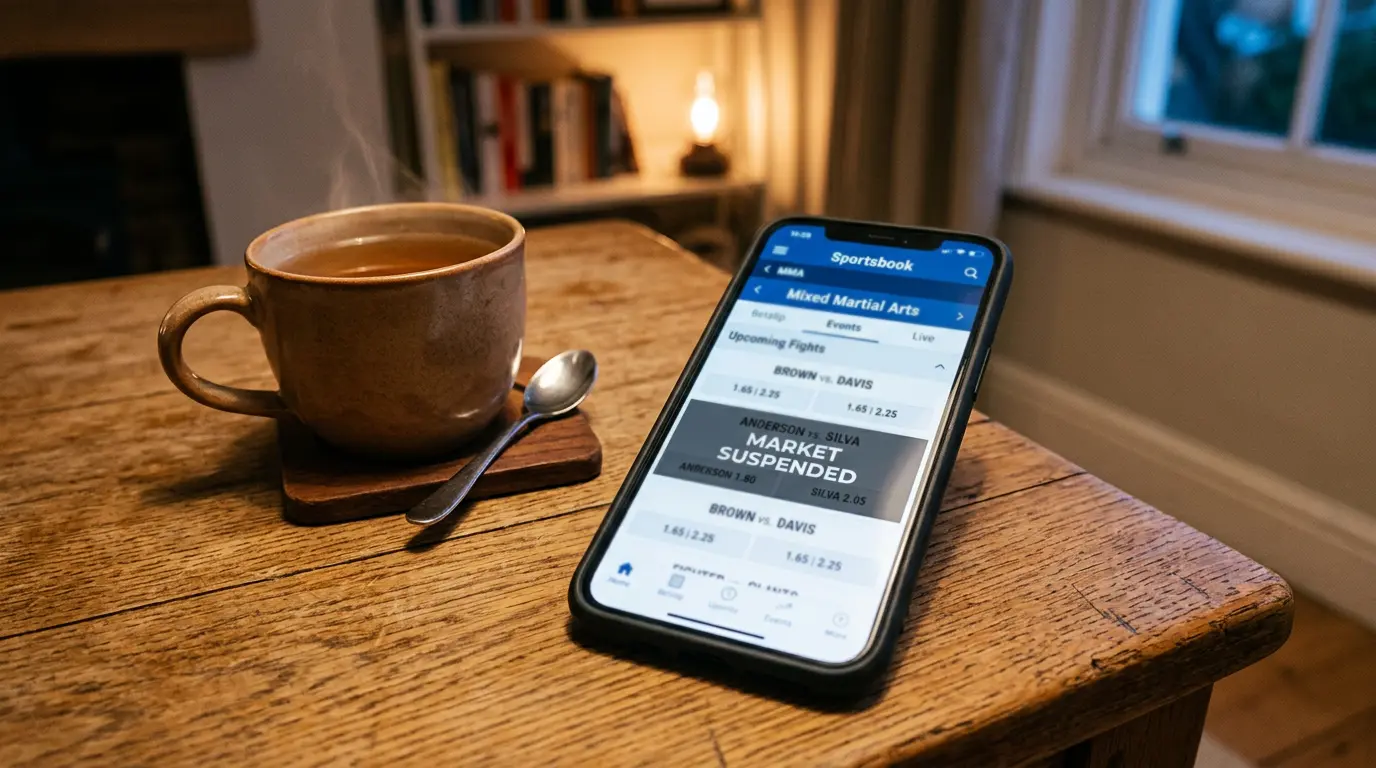
The first time I walked a mate through a UFC fight sheet on his phone, he closed the app after ninety seconds and told me he’d just stick to the football. I don’t blame him. You tap on a main event and a single fight unfolds into something like forty distinct markets — fighter to win, method of victory, round betting, totals, a dozen Bet Builder legs, a handful of novelty props nobody asked for. None of it is labelled in a way that actually helps a newcomer.
I’ve been pricing and chasing MMA markets on UK books for a decade, and I can tell you that most UFC markets are one of seven ideas dressed in different clothes. Learn the seven shapes and every sheet becomes legible. That’s what this handbook is for. I’m going to walk through every market a UK sportsbook offers on a UFC card — how it prices, how it settles, and the exact edge cases that get bets voided, restaked or, occasionally, paid out twice. I’ll use fractional odds throughout because that’s the UK default, and I’ll flag the grading quirks that differ between books.
If you want the wider view on reading those odds and computing your true edge, I cover that separately in my UFC odds guide for UK punters. Here I’m staying focused on the markets themselves — what each one is actually asking you to predict.
Moneyline: the simplest line, and the one most punters misread
Ask a casual bettor what “moneyline” means and half the time you’ll get a shrug. It’s the market where you pick who wins the fight. Nothing clever — a two-way line, no handicap, no round attached. Yet moneyline is where the bulk of UK UFC volume ends up, and it’s also where the most avoidable mistakes happen, because the pricing logic people use on football rarely translates to combat sports.
A typical UFC main event might look something like this on a UK sheet: Fighter A at 4/7, Fighter B at 13/10. That’s the book saying A is the favourite and B is the underdog. In decimal, 4/7 is 1.57, and 13/10 is 2.30. Stake four quid on A at 4/7 and you collect £2.29 profit plus your stake back if A wins. Stake four quid on B at 13/10 and a win returns £5.20 profit plus stake. Simple. The trap is that fight sports don’t behave like league sports. Historically UFC favourites priced anywhere from minus-four-hundred to minus-nine-hundred in American format — so decimal 1.25 down to 1.11 — have won between 88 and 93 percent of the time going back to 2013. That’s a lot of certainty you’re paying through the nose for. Underdogs across 2023 and 2024 cashed around 30 to 35 percent of the time, which sounds low until you remember that a dog priced at 3.00 only needs to win 34 percent of fights to break even. That maths is why I spend more time hunting live-dog value on UK books than I do shopping short-priced favourites.
There is no draw option on a UK UFC moneyline by default. A majority draw or split draw is rare but it happens — roughly one fight in every fifty or sixty — and when it does, most UK books treat the moneyline as a push and return your stake. A handful of sportsbooks list a three-way market with the draw priced in at something like 40/1, and if you’ve taken that market, a draw obviously settles on the draw selection rather than voiding. Always check which version of the market you’re actually in before the cage door shuts. I’ll occasionally see a punter moan that his fighter “won” a draw-priced bet because the scorecards favoured his guy, but a majority draw is a draw on every book I’ve used.
Pick’em fights — contests where both fighters are priced at evens or close to it, 10/11 either way is common — deserve their own mention. A pick’em line tells you the market can’t split the two. For the punter, the calculation changes: you’re no longer paying a premium for certainty, you’re effectively getting a coin flip at fair-ish odds after the book’s margin. I treat these as either “bet on information you actually have” or “skip”. There’s rarely a middle ground worth chasing, because the variance eats casual punters alive when the overround on a two-way pick’em typically runs three to five percent against you.
Method of victory: where a fight stops being binary
There’s a reason seasoned MMA punters spend more time on method of victory than on the headline moneyline. This is the market that rewards actual knowledge of how a fighter wins, not just whether they do. It’s also the market where the bookmaker’s margin climbs sharply, so it punishes guessing.
The standard UK version of this market splits the fight into six outcomes for a two-horse race: Fighter A by KO/TKO/DQ, Fighter A by Submission, Fighter A by Decision, and the same three for Fighter B. Occasionally you’ll see a seventh line for “Draw” priced deep. The quirk to remember is that DQ — disqualification — usually settles inside the KO/TKO bucket at UK books, because from the scorecard’s perspective a DQ is a forced stoppage rather than a fight going to the judges. So if a fighter wins by a DQ call (illegal elbow from the loser, fence-grabbing that ends the bout, any of that) and you’ve backed “Fighter A by KO/TKO”, you tend to cash. Two books I’ve used over the years bucket it differently — one grades DQ to the KO/TKO line, another treats it as a separate line that voids both KO/TKO and Decision — so check your book’s grading rules before you assume. This is boringly important: on the rare card where a DQ happens, the entire fate of your slip depends on one sentence in your bookmaker’s T&Cs.
Submissions are where the maths gets interesting. A KO market for a big heavyweight favourite might be priced at 6/4, a TKO at 9/4, a decision at 5/2. The submission line might sit at 10/1 or 14/1 because the book’s model looks at his career finish style and concludes he’s a puncher. If you know something the model doesn’t — maybe the other corner has a jiu-jitsu black belt as a coach, maybe the favourite’s takedown defence has been leaking at training-camp weight cuts — you’ve suddenly got a genuine edge. I’ve placed submission-bet tickets at 12/1 on underdogs priced at 3/1 on the moneyline and had them cash inside a round. That’s not skill so much as pattern recognition, and it only works if you actually watch the fights rather than reading the tale of the tape.
Decision markets price the opposite assumption: two fighters who are either durable, cautious, or stylistically poor finishers. If both fighters have finished under 40 percent of their career opponents, the decision line tends to be the value play on the board — often at evens or shorter despite the combined prior suggesting the fight is a coin flip inside a longer fight. The reason UK books hold this line down: they know punters love the “it goes the distance” safety story.
Double chance variants are the other wrinkle. A “Fighter A by KO or Decision” bet pays if either happens — it’s literally the sum of the two individual paths. Useful when you’re confident the fighter wins but unsure how. Two situations where I always consider the double chance: a wrestler on a short week of preparation, because they’ll either grind out a decision or stop a faded opponent late; and a striker defending late in camp, because the flash-finish path and the decision path are the two realistic shapes. The trap is that books price the double chance with a fatter margin than the two legs combined — often an extra two percent of overround — so you’re paying for the convenience of not splitting stakes.
Round betting: picking the round the fight ends
Round betting is what happens when method of victory and moneyline have a rowdy child together. You’re picking the exact round the fight ends in, plus the fighter who ends it. It’s a low-hit-rate market — most lines will price a correct pick between 5/1 and 25/1 depending on the fighter and the round — but when it hits, the payout is memorable. Worth keeping that honestly in mind before you stake: you’re chasing a small-probability outcome for a large multiplier, and the variance is brutal.
On a three-round preliminary fight, the market offers Fighter A in R1, R2, R3, and “by decision” — same for Fighter B. A five-round main event adds R4 and R5, which changes the pricing curve completely. A five-round championship contest stretches the window, but also thins the odds in the middle rounds because a tired fighter is more likely to get stopped when there’s more fight to unfold. I’ve found the cleanest value in R4 and R5 picks on main events where one fighter has a documented cardio advantage — late-round-stoppage bets against fighters who’ve been finished in round five of their last title fight are not complicated to spot.
Settlement rules are where the small print matters. If the fight goes the full three or five rounds, your “Fighter A in R2” bet loses because the fight didn’t end in R2. You do not get a void, you do not get a partial refund. The only clean void scenario is a no contest — fighter can’t continue because of an accidental foul in early rounds, illegal strike nullifies the result, fight is stopped and declared a no contest. In that case round betting tends to settle as a void and stakes return. A technical decision after a cut from an accidental headbutt is treated differently at different books: some settle round betting as “by decision”, others void. Rules file, again.
Finishing-round patterns carry signal worth reading. UFC data across the last three seasons shows a pronounced weight-class effect: heavyweight finishes cluster in rounds one and two, while bantamweight and featherweight finishes skew later as the fatigue gap opens up in rounds three and four of a five-round fight. If you’re backing a flyweight or bantamweight at round-one, you’re paying for an outcome that statistically happens less often than the market implies — the round-one market in lighter weight classes often carries more margin than the four or five-round alternatives combined. That’s not me telling you to avoid it; it’s me telling you the maths are against you more than the odds suggest. A round-three finish pick on a featherweight title fight, by contrast, is often the genuine mispriced corner of the market.
Total rounds over/under: the market people misread most
The total rounds market is the quiet workhorse of UFC betting. The main event typically opens at a line like “Total rounds 2.5”, with Over and Under priced around even money or slightly either way. You’re not picking a winner — you’re picking whether the fight lasts longer than the half-round threshold or ends before it.
Half-round lines exist because a UFC round is five minutes. The 2.5 line cashes Over if the fight reaches 2 minutes 30 seconds into round three. A fight stopped in round one, round two, or the first 2:29 of round three all settle as Under. The 1.5 line cashes Over at 2:30 of round two. This is the single most common settlement confusion I see: punters assuming Over 2.5 means “the fight needs to hit round three at all”, then losing on a round-three stoppage at 1:45 and genuinely believing the book owes them a refund. It doesn’t. The half-round rule is standard across every UK book I’ve used.
On three-round prelims the typical totals listed are 1.5 and 2.5. On five-round main events you’ll get 2.5, 3.5, and 4.5 — sometimes a 1.5 too, for fast-finisher matchups. The 4.5 line on a five-rounder is one of the best-priced markets in MMA, in my experience, because it asks a narrow question: can this fight go basically to a decision, or not? The overwhelming majority of five-round main events that go past round four end up going the distance, so Over 4.5 is often a proxy for the decision line with a slightly different margin. If the decision line is 11/10 and Over 4.5 is 6/5, I’m often taking the 6/5 even though the information content is nearly identical.
Alternate lines are listed at longer-than-main thresholds: Over 0.5 (fight completes round one), Over 3.5 on a five-rounder, sometimes Over 5.5 for fights that hit overtime in specific interim-belt formats. Alternate totals reward specificity — if you’ve made the call that a fight ends in round three and not before, Over 2.5 combined with Under 3.5 gives you a double-sided grip on the middle window. That’s essentially a synthetic round-three bet at what’s often a better implied price than the round-three straight line.
Line movement on totals is heavily event-driven. Books set opening totals days or sometimes weeks before fight week, then adjust on weigh-in news, camp reports, and late betting volume. A successful weigh-in where both fighters make weight cleanly doesn’t usually move totals. A fighter missing weight by three pounds and coming in visibly depleted moves the Under substantially — the short-notice stoppage becomes more likely. I keep a notebook of open-to-close movement on totals precisely because it’s the cleanest signal of where sharp money thinks the fight will break.
Fight goes the distance: the two-way sibling of the totals market
“Fight to go the distance” is the cleanest yes/no market on the sheet. You’re asking one question: does this fight end by the judges’ scorecards or by any form of stoppage? Yes means both fighters are standing when the final horn sounds and no disqualification or no contest interrupts. No means a finish — KO, TKO, submission, DQ, technical stoppage, anything that isn’t a scorecard result.
The fun of this market is how often it misprices against the totals line. On a three-round fight between two good strikers, the Over 2.5 rounds line might be 10/11, while “Fight to go the distance — Yes” might be priced at 4/5 on the same book. Logically, Yes and Over 2.5 are nearly the same bet, but because punters see “goes the distance” as a different question, books sometimes hold a wider margin on one side than the other. I’ve cashed a fair few free rolls over the years by taking whichever version of the same wager is priced slightly longer that afternoon.
Technical decisions are the settlement edge case to watch. If a fight is stopped in the fourth round of a five-rounder after an accidental headbutt and goes to the scorecards for a technical decision, most UK books treat that as “goes to distance: No” because the fight didn’t reach the final horn. A handful of books grade it as “Yes” because the judges decided it. If you’re loading the market, you want to know which camp your book sits in.
Stoppages due to injury between rounds are treated as finishes on every UK book I’ve seen — your Yes bet loses and the “No” bet cashes on the TKO line. A doctor stoppage at the end of round one because of a cut that won’t close settles the same way. None of this is dramatic once you know the rules, but the wrong guess on settlement direction costs a lot more than the wrong guess on the outcome itself.
Method and round combo: where the bet slip starts to pay real money
This is where the payouts get interesting. Method and round combo asks you to pick exactly how and when the fight ends — Fighter A by KO/TKO in round two, say. A single correct combo pick on a main event often prices between 8/1 and 40/1 depending on the matchup. It’s essentially a slice of round betting with method baked in.
Think of it as the three-way intersection: the fighter, the method, and the round all have to land. On a heavyweight fight where the favourite is priced 4/6 on the moneyline and is a known finisher, the “Fighter A by KO in R1” combo might be 7/2. Compare that to the round-one line for Fighter A at 4/1 and the method-KO line at 11/10, and you can see the book is charging a premium for combining them even though a specific outcome combo on a heavyweight is nearly correlated with a round-one stoppage.
Correlated legs are the reason combo markets are priced higher than the naive product of their parts. Because method and round aren’t independent — a submission is more likely in later rounds, a KO is more front-loaded — UK books use a joint model and typically add two to three percent of margin on top. Useful to know before you assume the combo is equivalent to building the same thing through a Bet Builder, which may apply its own correlation penalty.
The genuine value window is on five-round main events. The market often holds late-round method combos at inefficient prices — particularly “Fighter B by submission in R4 or R5” on fights where the underdog is a grappler fighting a fading striker. This has been one of my most reliable micro-angles over the last three or four years. Not every card offers it, but when the matchup fits, the combo is often priced 25/1 or 33/1 on a fighter whose path to winning a fight genuinely runs through grinding his opponent’s cardio and finding the neck late.
Niche and exotic markets: novelty props worth your attention and worth ignoring
The bottom of every UFC market sheet carries a collection of props that either reward deep knowledge or punish casual interest. The mix varies by UK operator, but the shapes repeat across the board.
“Fight ends in the first minute” — sometimes listed as “gone in 60 seconds” — is the purest novelty line. It hits on maybe one in thirty UFC fights across a season, and the market prices it anywhere from 12/1 to 40/1 depending on matchup. Genuinely attractive when you’re backing a heavyweight pressure-striker against an opponent who’s been dropped early in his last three fights. Genuinely useless when you throw it on a card for fun because you think “fast finish” is a vibe. The hit rate is too low for anything but targeted plays.
Time of finish is a bracket market — “fight ends between 0:00 and 2:30 of round one”, “between 2:31 and 5:00 of round one”, and so on through the rounds. Twelve brackets on a three-round fight, twenty on a five-rounder. Every bracket prices between 6/1 and 60/1. The information requirement to beat this market is real: you need a view not just on who wins and how, but on when in the round they land the finish. I rarely touch it unless I’m genuinely convinced about a late round-three stoppage in a fight where the metrics support it.
Performance props are the market I use most of this category. “Over X.5 significant strikes landed by Fighter A”, “Over X.5 takedowns landed by Fighter B” — these reward punters who actually watch tape. If you know Fighter A absorbs fifteen strikes a minute and has never defended more than three takedowns in a fight, you can build a position on the strikes-absorbed line that the book’s model sometimes misprices because it averages across the fighter’s career rather than weighting recent performance. Most UK books offer five to ten performance lines per main-event fighter; a couple offer them only live, which narrows the window but also sharpens the price.
“Both fighters knocked down” is the curious coin-flip prop. Yes prices around 8/1 to 15/1 on strikers, longer on grappling matchups. Over a fifty-fight sample I’ve tracked, this one hits more often than the implied probability on short-notice fights where both corners are throwing caution out the cage door. Not a market I build around; a market I’ll throw a tenner on when two big punchers meet with bad defensive records.
Novelty-heavy markets — “fight of the night bonus”, “bonus won by either fighter” — exist on a handful of UK books, carry huge margin (often six to eight percent overround), and are almost exclusively a way to part with your money for the entertainment of a slightly extended cage walk. Useful to know they exist. Not useful to build a position around.
When a fight is cancelled, voided or replaced at short notice
Every UFC card gets a late-scratch scare at some point. A fighter wakes up sick, a weight cut goes sideways on the scale, a doctor refuses clearance forty-five minutes before the walk. What happens to your bets depends on when the change happens and what the book’s rules file says. This is the least-read corner of every sportsbook’s terms and conditions and the place where most disputes originate.
The clean case: fight is cancelled, never happens, never rescheduled to the same card. Every UK book voids your bet and returns the stake. That applies to moneyline, method, round, totals, distance, combos, and props on that specific fight. If you’ve rolled that fight into an accumulator with other legs, the cancelled leg voids and the acca recalculates on the remaining legs. Straightforward.
The less clean case: fighter A is replaced by a short-notice opponent. Most UK books void every bet on the original matchup — if you backed Fighter A on the moneyline, that stake comes back because the opponent changed. A few books have a narrower rule where moneyline on Fighter A stays live and only opponent-specific bets (round betting involving Fighter B, method-of-victory combos with B) void. I’ve been bitten by this once. Assume broadly that a replaced opponent voids the market unless the book’s rules page says otherwise.
Postponements to a later card are handled inconsistently. One book will keep your bet live for 48 hours, then void if the fight isn’t rearranged within that window. Another will void immediately the moment a rescheduling is announced. A third will only void if the fight shifts outside a calendar week. Check the relevant clause before you argue with a customer-service agent who will almost certainly quote the rules back at you.
Partnerships between UFC and its global sportsbook partners have shifted the institutional landscape here — Nicholas Smith, Vice President of Global Partnerships at UFC, has spoken about bet365’s renewed UK and Ireland deal as a relationship where the operator has invested in growing MMA through educational content and shared operational innovation. Practical implication for the UK punter: the more deeply a book is integrated with the promoter, the faster their grading tends to update when late changes happen on fight week, and the cleaner their dispute path. Doesn’t make their rules file more generous. Does tend to make their settlement more predictable.
No contests are their own beast. If a fight is stopped and declared a no contest — accidental foul, fighter can’t continue from an inadvertent strike, both fighters land a simultaneous knockout the commission rules as NC — moneyline usually voids and stakes return. Method of victory voids. Round betting voids. Totals are where rule variance gets painful: some books settle totals to the point of stoppage (if the fight was stopped in the middle of round two, “Under 2.5” cashes), others void the market entirely. Same fight, same stoppage, two completely different outcomes on your bet slip depending on which app you’re holding.
Settlement questions UK punters ask me most
Four questions come up over and over on UFC markets, and they’re always the ones that matter most for your slip. I’ll answer each in the FAQ block below with the exact grading UK books apply — these are the rules I’ve confirmed across the major UK sportsbooks over the last two years of placing bets.
One thing worth keeping in mind before you scan through: market grading is the single most profitable area of self-education for a UFC punter. Knowing the answer to the DQ question or the no-contest question before the fight starts is worth more than another hour of tape study on the fighter. You can’t influence the fight, but you can absolutely control whether your bet is structured to survive a messy ending. The edge you build through cleaner market selection is frequently more repeatable than the edge you build through pick accuracy.
Yes cashes if both fighters are standing at the final horn and no stoppage interrupts the scheduled rounds. No cashes on any finish — KO, TKO, submission, DQ, or technical stoppage before the horn. A technical decision after an accidental foul in a late round settles as No on most UK books because the fight didn’t reach the final horn. One or two books grade it as Yes. Check your book’s rules page before you stake. Moneyline, method of victory, round betting, combos, and props all void and your stake returns across every UK book I use. Totals are the exception: some books settle totals to the point of stoppage, others void. Same stoppage, two outcomes depending on the operator. Read the totals clause in your book’s combat-sports rules before you load that market. Only if your book lists a three-way market with a draw selection priced in. That’s unusual — the default UK moneyline is two-way, and a majority or split draw voids both sides and returns stakes. A few books offer a separate ‘fight result including draw’ market with the draw at around 40/1. Check the fight page; if the draw isn’t listed, you cannot bet on it. Novelty and exotic props — fight of the night bonuses, narrow time-of-finish brackets, specific-foul props — carry the widest overround, often six to eight percent above the implied-fair line. Method and round combo markets come second at around four to five percent. Moneyline on a balanced main event is usually the tightest, typically three to four percent. If you’re value-hunting, the moneyline and main totals line are where the maths are least hostile.What does ‘fight goes the distance’ mean for my bet settlement?
If a UFC fight is declared a no contest, what happens to my wager?
Can I bet on a draw in a non-title UFC fight?
Which UFC market has the largest bookmaker margin in the UK?
Created by the ”Best Place to bet on ufc” editorial team.